The Pioneer Valley has unusually deep stock of preserved domestic architecture, and four house museums, taken together, read almost as a strata of the region’s social history. The 1786 Storrs House in Longmeadow is the parsonage of a long-serving country minister. The 1805 Leonard House in Agawam is a Federal-era stage-road tavern by Asher Benjamin. Wistariahurst in Holyoke is the Gilded-Age home of a silk-manufacturing family whose money came from the Valley’s industrial second act. And the Bryant Homestead in Cummington is the hilltown country house a famous poet bought back from his relatives in middle age. Done in a long day, the four houses run roughly south-to-northwest across the Valley, and each one captures its era better than any street or downtown can.
Stop 1: Storrs House Museum (Longmeadow)
Start at the Storrs House Museum on Longmeadow Street in Longmeadow, the 1786 parsonage of Rev. Richard Salter Storrs, the long-serving second pastor of the First Church of Christ in Longmeadow. The building is a textbook Federal-era center-chimney colonial: white clapboard, five-bay symmetrical façade, twelve-over-twelve sash, and a panelled green door, set well back on the broad linear Town Green. The Storrs family lived here for three generations; in 1932 the house was moved south and back about thirty feet to make room for the Storrs Library next door, and the Longmeadow Historical Society has run it as a museum ever since.
The Society is small and volunteer-run. Public hours are the first Wednesday and third Saturday of every month, 1–4 PM, and otherwise by appointment; call ahead.
Stop 2: Captain Charles Leonard House (Agawam)
Drive about eight miles west across the river to the Captain Charles Leonard House at 663 Main Street in Agawam Center. Built in 1805 and attributed to Asher Benjamin (the New England architect whose pattern books taught a generation of country builders how to work in the Federal idiom), it opened as Agawam’s fourth tavern and the first overnight stop on the Hartford-to-Boston stage road. The façade is unmistakable: two-story paired Doric columns flanking a recessed center entry, a tall arched Palladian window above the door, and an elliptical fanlight at the gable end.
The house is privately operated as an event venue and does not keep regular public museum hours. The exterior is fully visible from Main Street, and the trustees occasionally open the building for community events; otherwise the way to see the interior is to attend an event held there or to inquire directly.
Stop 3: Wistariahurst (Holyoke)
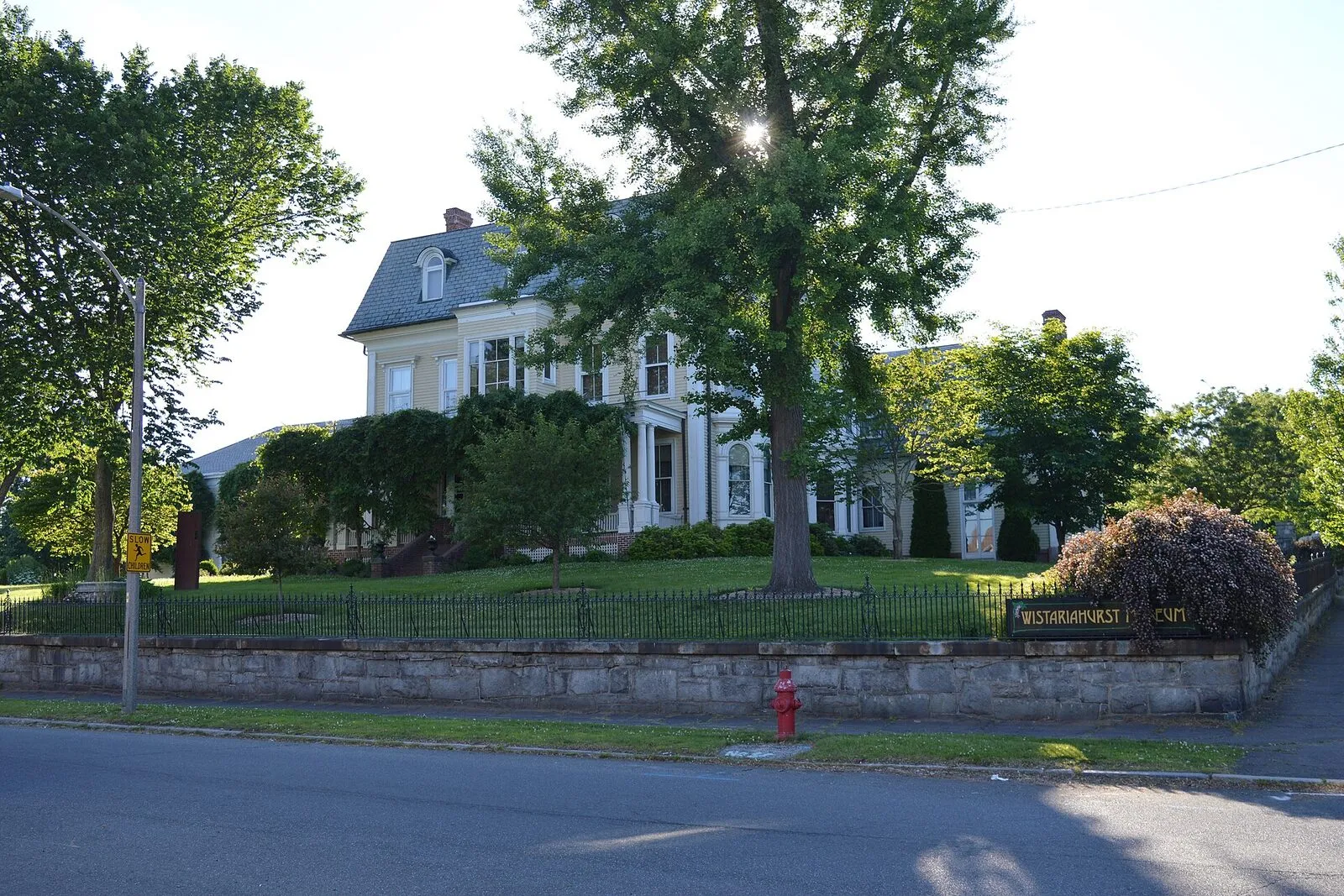
Twenty miles north to Holyoke and Wistariahurst, the former home of the Skinner family, whose Skinner Silk Manufacturing Company was one of the largest silk operations in the country in the late 19th century. The house was originally built in Williamsburg in 1868 and physically moved to Holyoke in 1874, after the Mill River dam disaster destroyed the Skinners’ first factory. Donated to the City of Holyoke in 1959, the house is now a city-run museum.
This is the high-Victorian end of the strata: period rooms preserved largely as the Skinners left them, with original silk wall coverings, Tiffany-glass details, and Belter-style furniture; a sunlit Beaux-Arts conservatory added in 1914 with stained glass and a checkerboard-tile floor; two acres of landscaped grounds; and the namesake wisteria still climbing the porch. The museum is open for drop-in tours several days a week, but private events sometimes close public access; check the website before you go.
Stop 4: Bryant Homestead (Cummington)
For the last leg, climb thirty miles northwest into the hilltowns to the William Cullen Bryant Homestead in Cummington. The 1783 farmhouse was built by Bryant’s maternal grandfather; his father bought it in 1799, and the future poet lived here from about age four until he left for a legal career at twenty-two. He drafted “Thanatopsis” as a teenager in these hills. After a long New York editing career, Bryant bought the family farm back in 1865 and returned every summer for the rest of his life. His granddaughter donated it to The Trustees of Reservations in 1929, and it was designated a National Historic Landmark in 1962.
The grounds and the Rivulet Trail (a short loop through old-growth pine and hemlock) are open daily, sunrise to sunset, free year-round. House tours run only on a handful of dates each summer, typically one Saturday a month from late June through September; the Trustees site posts the current dates and is the canonical source. Plan the Bryant leg for fall foliage if you can: the hilltowns turn about a week ahead of the Valley floor.
Practical notes
- The full south-to-northwest run is about seventy miles end to end. It comfortably fits a long day; a more relaxed two-day version can split it at Holyoke.
- All four houses have limited public hours. Storrs is open one Wednesday and one Saturday a month; the Leonard House is event-only; Wistariahurst is seasonal and event-prone; the Bryant House interior opens on a handful of summer Saturdays. Confirm hours on each site’s website before driving.
- The drive between Wistariahurst and the Bryant Homestead climbs about a thousand feet into the hills along Route 9; reduce the day by an hour or two if winter weather is in the forecast.
- Architectural eras: Federal (Storrs, Leonard) → late-Victorian / Gilded Age (Wistariahurst) → 18th-century farm + Victorian addition (Bryant). The progression rewards visiting in that order.