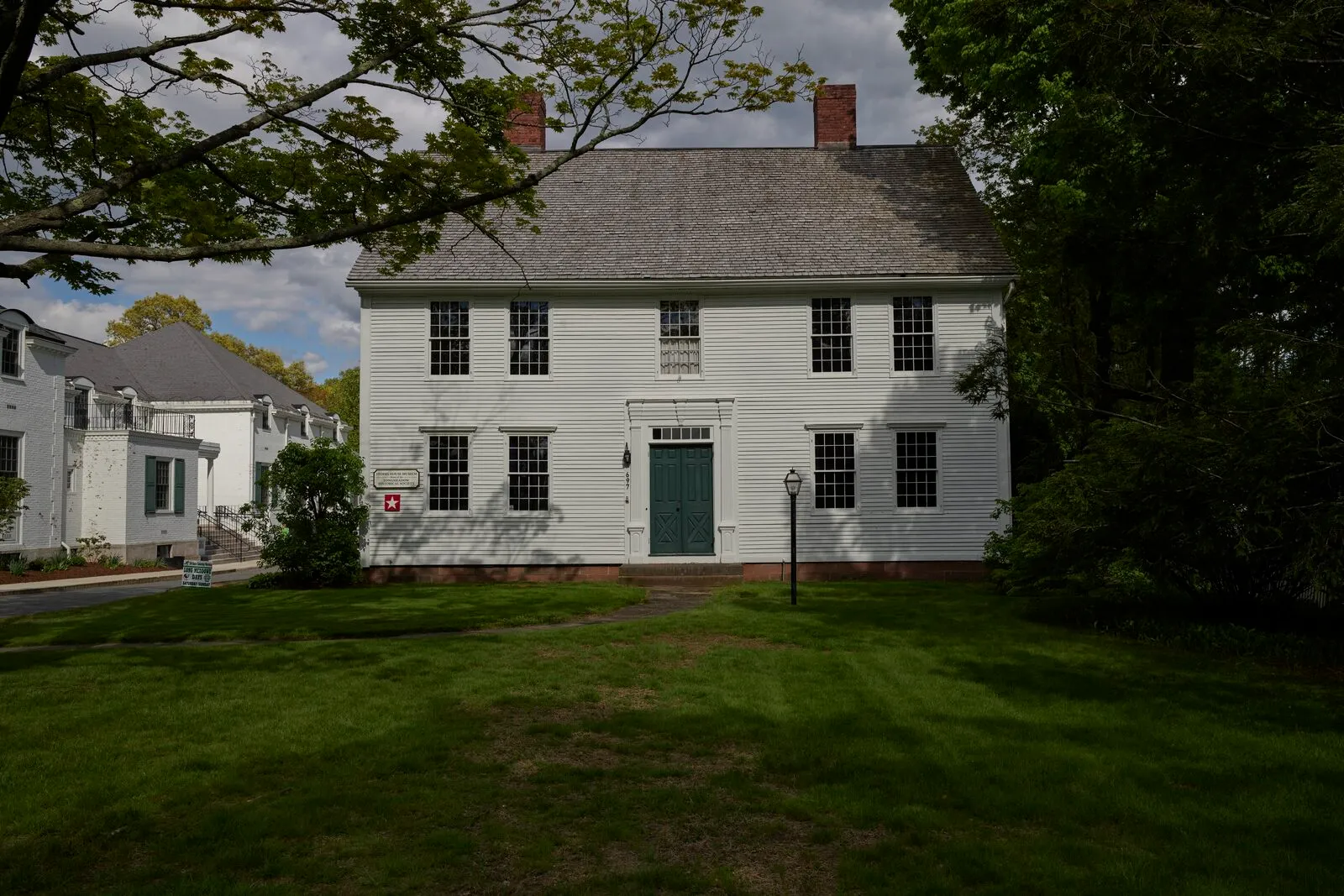
The Storrs House is the 1786 parsonage built for Rev. Richard Salter Storrs, the second pastor of the First Church of Christ in Longmeadow and a long-serving minister of the parish from 1785 until his death in 1819. Three generations of the Storrs family lived in the house; the last, Sarah Storrs, left it and matching funds in her 1907 bequest that built the Richard Salter Storrs Library next door.
When the library was constructed in 1932, the house was moved to its present spot (about twelve feet south and thirty feet back from the street) and the Longmeadow Historical Society took it on as its museum. The building is owned by the Storrs Library Association; the Society has maintained it ever since.
It is a textbook Federal-era center-chimney colonial: white clapboard, five-bay symmetrical façade, twelve-over-twelve sash, panelled green door, set back on the broad linear Green that runs the length of Longmeadow Street.
What to see
- Period rooms. The Society keeps several rooms furnished in period, including the southeast room used in the 1860s by Lucy Storrs (Sarah’s sister) for a private girls’ school.
- Storrs and Williams family papers. The Society’s collections include manuscripts, account books, and household items from generations of Longmeadow ministerial families.
- The Town Green. The house sits on the wide, set-back stretch of Longmeadow Street that makes up the National Register Longmeadow Historic District.
- Storrs Library next door. The 1932 building that prompted the house’s relocation, and a working public library in its own right.
Visiting
The Storrs House is open to visitors on the first Wednesday and third Saturday of every month, 1–4 PM, and otherwise by appointment. The Society is small and volunteer-run, so arranging a visit ahead is the surest way in. The address is 697 Longmeadow Street, on the east side of the Green about a mile south of Longmeadow center.