Longmeadow is a Hampden County town of about 15,900 on the east bank of the Connecticut River, immediately south of Springfield. The land was originally part of Springfield’s 1636 plantation; English colonists settled the river-bottom flats here in the mid-17th century, abandoned the lower meadow after a destructive flood in 1695, and successfully petitioned in 1703 for permission to rebuild on the higher gravel terrace east of the floodplain, the upper street that holds the modern town. Longmeadow was set off from Springfield and incorporated as a separate town on October 17, 1783.
Longmeadow Street and the Green
The center of town is the Longmeadow Historic District, a mile-and-a-half stretch of Longmeadow Street running north– south through the village center, and the linear Town Green that runs down its middle. The Green is one of the longest in New England, deeply set back from the road on both sides, and flanked by 18th- and early-19th-century clapboard center-chimney colonials and Federal houses: the town’s surviving ministerial homes, parsonages, and merchants’ houses, with a few later Greek-Revival and Italianate infill. The whole corridor was listed on the National Register of Historic Places in 1982.
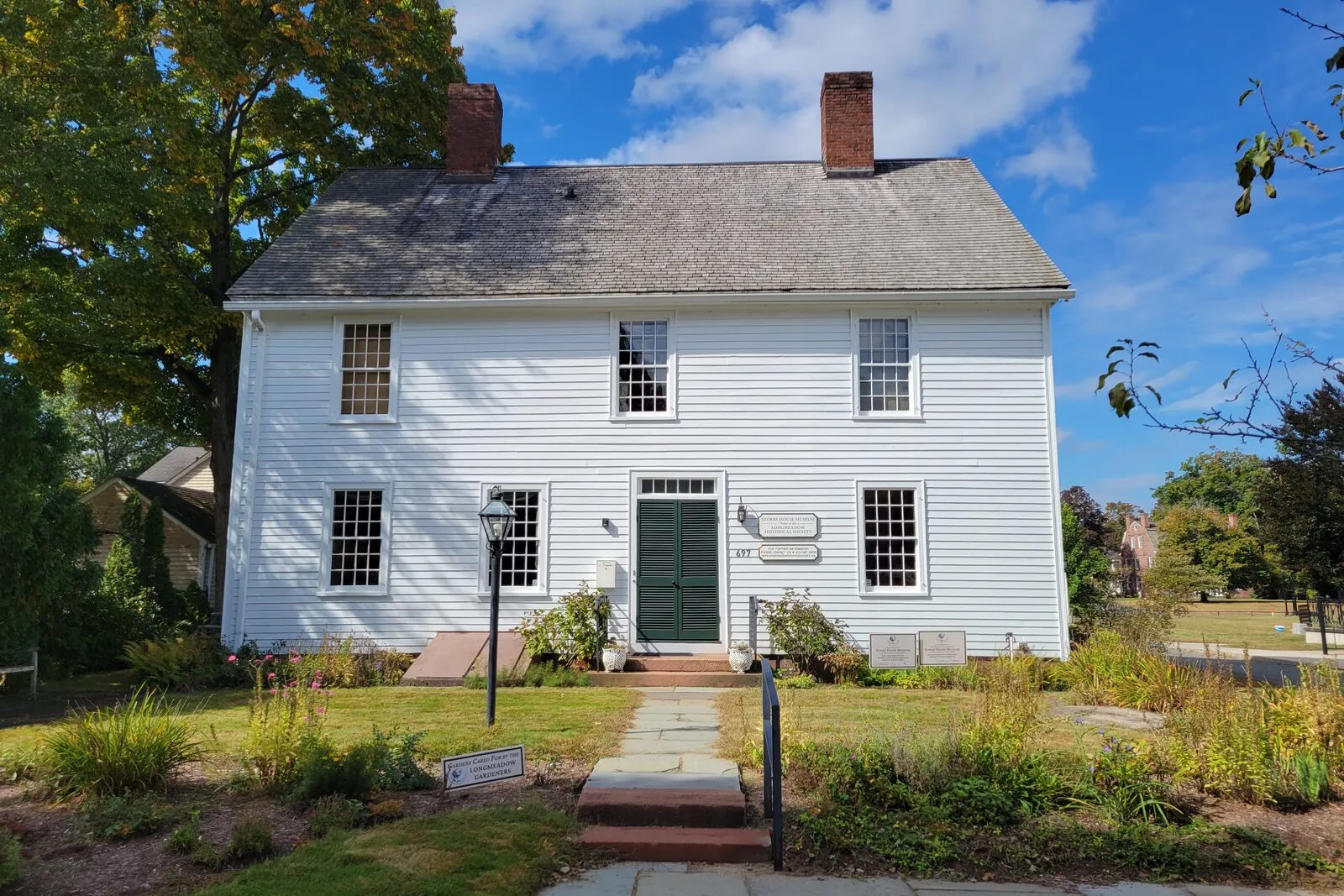
The Storrs House
The hero is the Storrs House Museum on Longmeadow Street, built in 1786 as the parsonage for Rev. Richard Salter Storrs, the long-serving second pastor of the First Church of Christ in Longmeadow. Three generations of the Storrs family lived in the house. In 1932, when the Storrs Library Association built a new library on the lot, the house was moved south and back about thirty feet, and the Longmeadow Historical Society took over its care; the Society has run it as a museum, with period rooms and the Storrs and Williams family papers and artifacts, ever since.
East Longmeadow and the brownstone quarries
The eastern half of the original town, the more populous “East Village,” built around the 19th-century East Longmeadow brownstone quarries that supplied stone for buildings across the Northeast, split off in 1894 and incorporated as the separate town of East Longmeadow. What remained on the Longmeadow side after 1894 is the more residential, river-leaning section, with the Green at its center.
Bay Path University
On the southwest edge of town is Bay Path University, a private institution founded in 1897 as Bay Path Institute, a business college in Springfield. It moved to its current Longmeadow campus in 1945, became a women’s undergraduate college through most of the 20th century, and is now a coeducational graduate university with a continuing women-only undergraduate program. The campus runs along the south side of Longmeadow Street and into the meadows beyond.
Other notes
- The town’s name is literal: a long meadow on the Connecticut River bottoms south of Springfield, abandoned by early settlers after one too many spring floods. Today’s river-bottom meadows are largely cropland and conservation land along the I-91 corridor.
- The First Church of Christ is the descendant of the parish organized in 1713 (its first meetinghouse went up on the Green in 1716); the current building is the 1767–1768 second meetinghouse, extensively remodeled in 1828 and again in 1874 when it was moved to its present spot at Longmeadow and Williams streets.
- Across the Connecticut River to the west is Agawam; to the east the brownstone-quarry town of East Longmeadow; and south, across the state line, Enfield, Connecticut.
Sources
- Town of Longmeadow
- Longmeadow, Massachusetts — Wikipedia (2020 U.S. Census population: 15,853)
- Longmeadow Historical Society — Storrs House
- Bay Path University