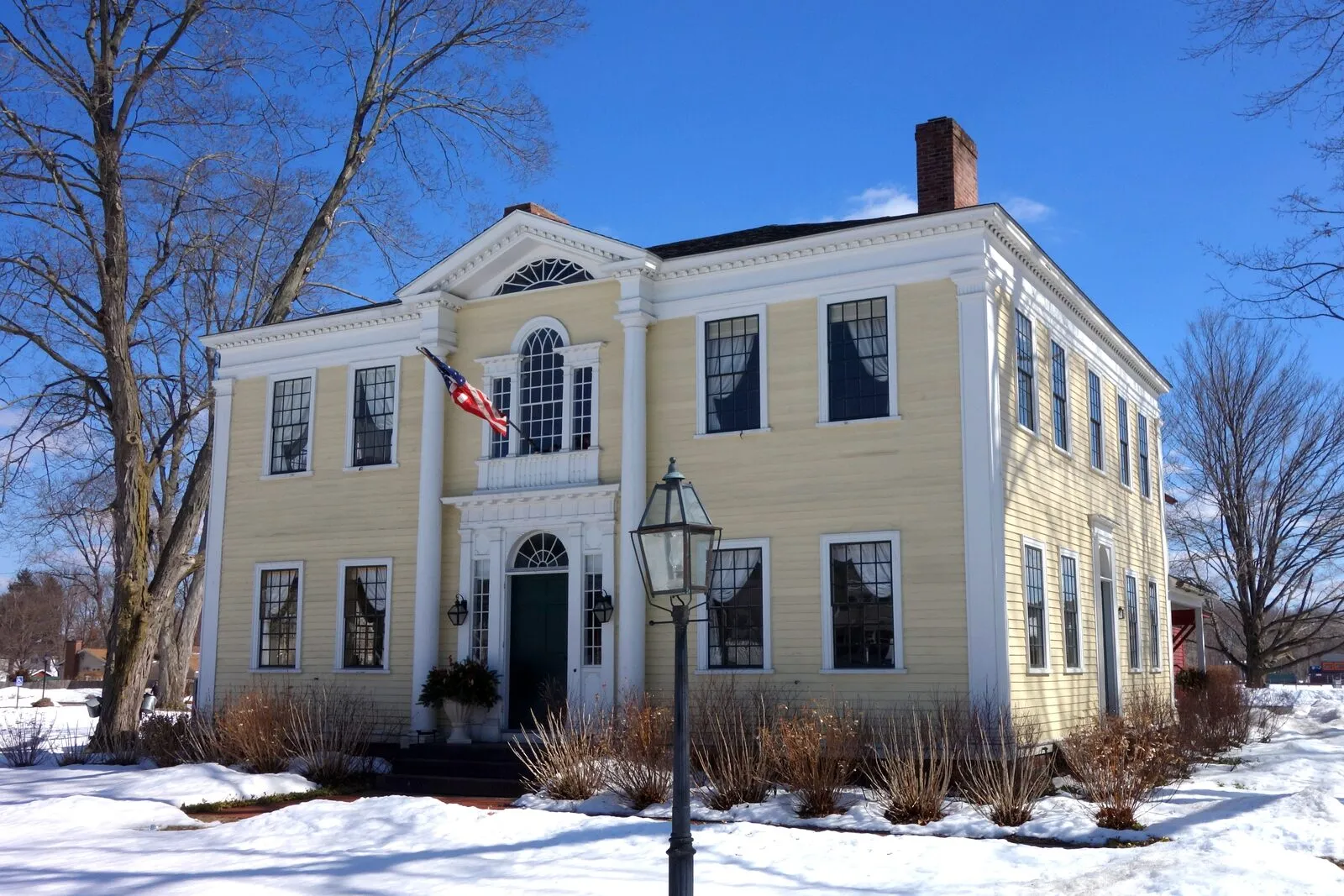
The Captain Charles Leonard House is an 1805 Federal-era mansion at 663 Main Street in Agawam Center, attributed to the New England architect Asher Benjamin, the same designer credited with several Boston churches and the early American architectural pattern books that taught a generation of country builders how to work in the Federal idiom.
Charles Leonard (b. 1764) was a Harvard graduate who returned to farming on the family land in Agawam and earned the title “Captain” while serving in the local militia. In 1805 he put up the house at the western end of his property as Agawam’s fourth tavern and the first overnight stop on the Hartford-to-Boston stage road. The building has been a fixture of the town’s social life ever since: a tavern, then private home, then rooming house, then (after a 1938 restoration commissioned by Mrs. Minerva Davis) a community gathering space.
The house was added to the National Register of Historic Places in 1975, and the surrounding Agawam Center Historic District followed in 2001. The trustees describe the Leonard House as the crown jewel of the district.
What to see
- The façade. Two-story paired Doric columns flanking a recessed center entry, a tall arched Palladian window above the door, an elliptical fanlight at the gable, and a hipped roof. It is the best surviving Federal building in Agawam, with proportions and ornament that show Asher Benjamin’s pattern-book vocabulary at small-town scale.
- The setting. The house sits well back from Main Street behind a large old ash tree, anchoring the north end of the Agawam Center Historic District. The surrounding stretch of Main Street is a continuous run of 19th- and early-20th-century buildings.
- The HABS record. The building was documented by the Historic American Buildings Survey in 1934; Arthur C. Haskell’s photographs and measured drawings of the house are available through the Library of Congress.
Visiting
The Leonard House is privately operated as an event venue (weddings, meetings, and private functions) and does not keep regular public museum hours. The trustees occasionally open the building for community events; otherwise the way to see the interior is to attend an event held there or to inquire directly. The exterior is fully visible from Main Street and is worth a brief stop on any visit to Agawam Center.