The Connecticut Valley has been the most important early-Jurassic dinosaur-track site in North America, more or less continuously, since 1802, when a twelve-year-old boy named Pliny Moody turned up an unusual sandstone slab while plowing his family’s field in South Hadley. Two hundred years on, the Valley still has more dinosaur tracks per square mile than anywhere else on the continent, and two of the best places to see them sit about twenty miles apart.
This is a half-day route that takes in both: the world’s largest dinosaur-track collection at the Beneski Museum of Natural History in Amherst, and an exposed track surface on the Connecticut River at Dinosaur Footprints in Holyoke, where the tracks are still in the rock the animals walked on, ~200 million years ago.
Morning: The Beneski Museum (Amherst)
Start in Amherst. The Beneski Museum of Natural History on the Amherst College campus holds the Hitchcock Ichnological Cabinet, about 1,700 sandstone slabs of dinosaur tracks collected by Edward Hitchcock, an Amherst College professor (and later president), between 1836 and 1865. The collection runs the length of one gallery wall and is the largest such anywhere in the world. Pliny Moody’s original “Noah’s Raven” slab is in there too, labeled as the oldest dinosaur footprint discovered in North America.
Allow at least an hour. The museum has three open floors (the first floor includes a mounted mastodon and a mammoth, and the lower level is a deep-time fossil timeline), but the Hitchcock wall on the upper level is the centerpiece. Free, generally Tuesday through Sunday.
Midday: Drive south to Holyoke
Drive south on Route 116 and Route 5, about 25 minutes through South Hadley to the river. South Hadley is where Pliny Moody made his 1802 discovery, but the field itself isn’t a public site. There’s no plaque, no exhibit, just a town that happens to sit on the right band of soft red Portland-Formation sandstone. You can stop in South Hadley Center for lunch (the Mount Holyoke College side has a few cafés on College Street) or push through to Holyoke and pick something up there.
Afternoon: Dinosaur Footprints (Holyoke)
Dinosaur Footprints is an eight-acre Trustees of Reservations site on Route 5 along the Connecticut River. A short, mostly flat trail drops about thirty feet from the small roadside lot to the riverbank, where exposed sandstone bedrock carries dozens of Eubrontes and smaller Grallator tracks, the same trackmakers as many of the slabs at the Beneski, but here in situ: on the horizontal mud surface where the animals actually walked. The largest tracks are about fourteen inches long.
Late summer and fall, when river levels are low, more of the track surface is exposed and the prints are sharpest. Bring a hat. The slab is unshaded and the rock holds the afternoon sun. Free, no fee, sunrise to sunset, April 1 through November 30.
Why these tracks are here
About 200 million years ago, near the start of the Jurassic, a long north-south rift valley opened across what is now central Connecticut and Massachusetts. The valley filled with mud, sand, and basalt; the mud and sand preserved the tracks left by dinosaurs walking the muddy edge of a shallow tropical lake, and the harder basalt layers later capped the soft sediments. Two hundred million years of erosion has stripped the soft layers from between the basalt caps, leaving the trap-rock ridges of the central Pioneer Valley (Mount Tom, the Holyoke Range, Mount Sugarloaf, Mount Toby) standing up. The dinosaur tracks turn up in the soft red Portland-Formation sandstone that fills the rest of the basin.
If you have an extra hour
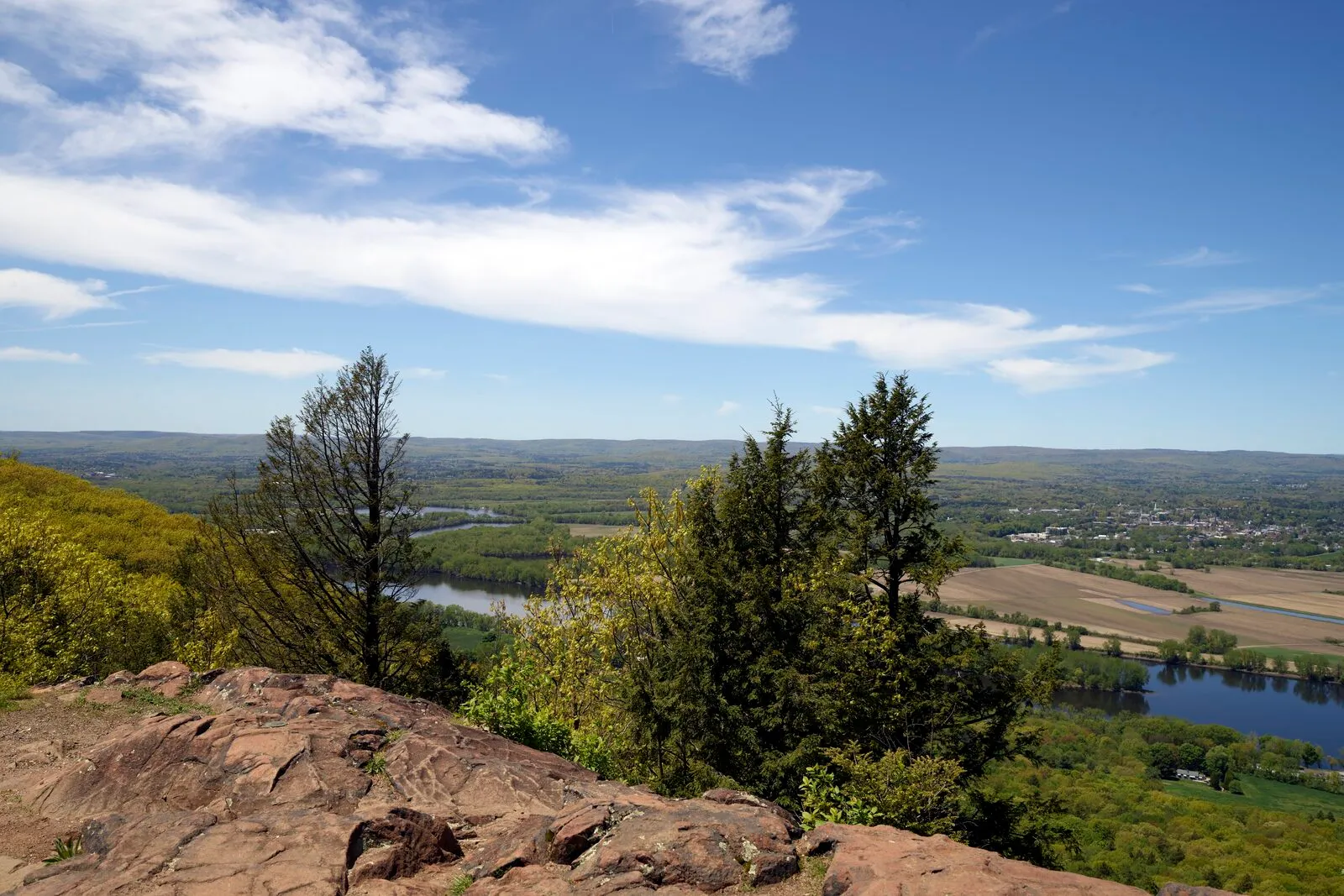
Drive up Mount Holyoke in J.A. Skinner State Park (Hadley side) for the best view of the rift basin from above: the Connecticut River winding through the valley below, the trap-rock ridges of Mount Tom across the river, and the pattern of soft sandstone farmland that’s still being plowed two centuries after Pliny Moody. DCR posts the auto road season each year; for 2026, Summit Road opened May 3 and the Summit House season begins May 23. The Mount Holyoke summit view is one of the most-painted landscapes in 19th-century American art (Thomas Cole’s The Oxbow, 1836), and it’s the same view that gives the dinosaur-track story its geographic frame.
Practical notes
- Allow 4–5 hours for the Beneski + Dinosaur Footprints loop; add an hour for the Mount Holyoke detour.
- The Beneski is closed Mondays and on most major holidays. Dinosaur Footprints is closed in winter (December–March).
- Both sites are free. The Mount Holyoke auto road charges a small parking fee in season.
- The Dinosaur Footprints lot is small (~7 spaces) and fills on summer weekends; weekday visits are easier.
- Stay off the slabs when wet, don’t chalk the prints, and don’t make rubbings. The sandstone is fragile and the tracks are slowly degrading.