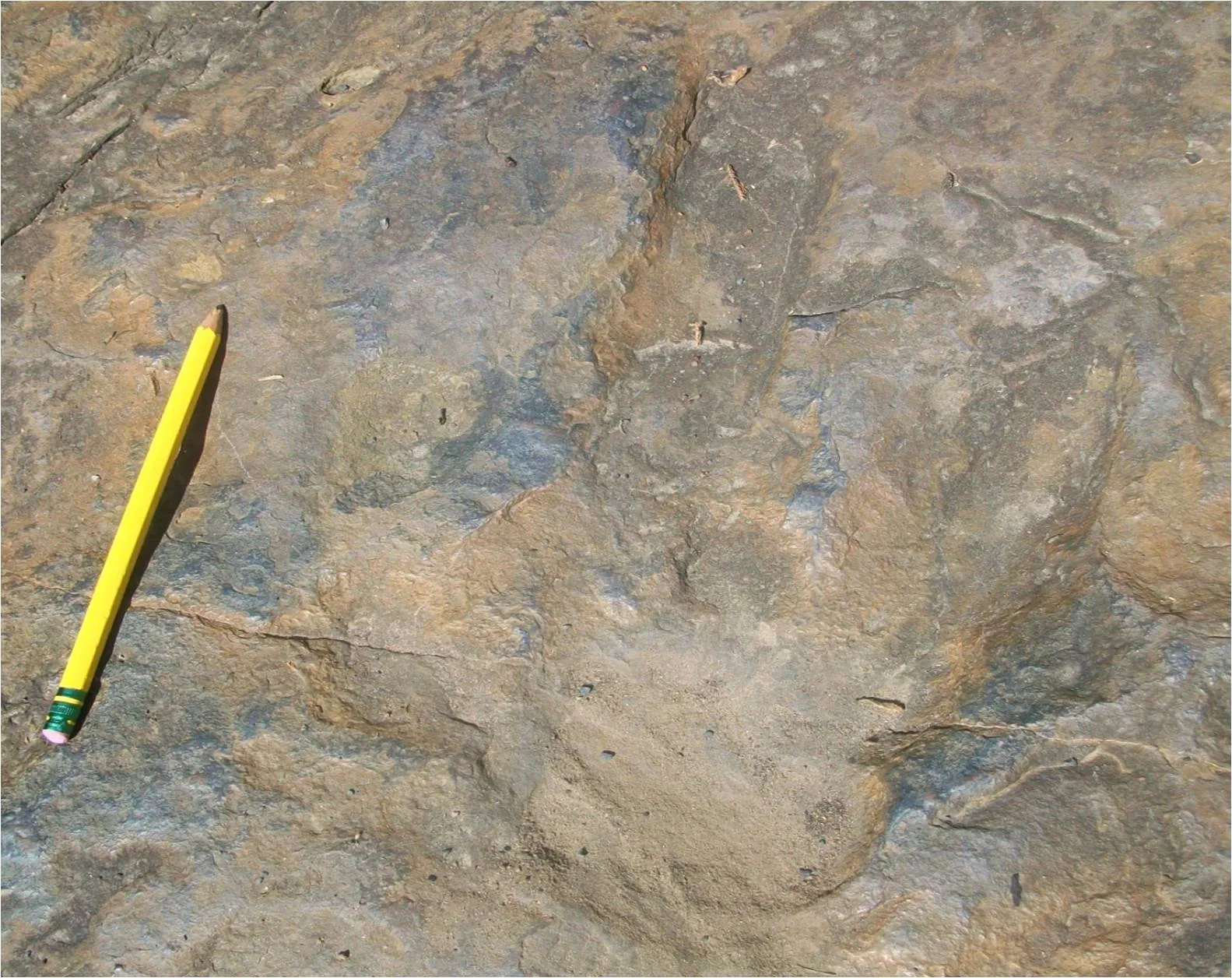
Dinosaur Footprints is an eight-acre Trustees of Reservations site on Route 5 in Holyoke, set on exposed Portland-Formation sandstone near the Connecticut River. The bedrock preserves dinosaur trackways (including Eubrontes and smaller track forms) laid down in mud roughly 200 million years ago, in the early Jurassic. Trustees interpret the site as the first dinosaur prints ever scientifically described.
What you can see
The track-bearing slabs are visible from a short, mostly flat trail from the parking turnout: a few minutes’ walk, longer if you stop to read the interpretive panels. Do not cross the railroad tracks: Trustees notes that there is no legal access to the Connecticut River from the reservation.
The Trustees describe more than 20 trackways and four distinct dinosaur track types, with larger Eubrontes prints likely made by animals about 15 feet tall and 20 feet long. They walked the muddy edge of a shallow tropical lake that filled the rift basin in the early Jurassic. The same lake mud, lithified into sandstone, is exposed across the central Pioneer Valley in road cuts and quarry walls, but this is one of the few places in Massachusetts where you can see the tracks in situ, on the horizontal surface where the animals actually walked.
What to know
- Open April 1 through November 30, sunrise to sunset. Closed in winter; the path down to the river ices over.
- Free: no admission, no fee.
- Small lot: about seven roadside spaces on Route 5 directly opposite the main entrance. The lot fills on summer weekends.
- No facilities: no bathrooms, no water, no rangers.
- Stay off the slabs when wet; the sandstone is fragile and the tracks are slowly degrading. Don’t chalk the prints, make castings, or cross the railroad tracks.
- Dogs: must remain on leash.
- No swimming, no hunting.
The collection at the Beneski Museum of Natural History at Amherst College, twenty miles north, holds the same kinds of tracks (and many more) on quarried slabs mounted on a gallery wall. The two visits pair well: the river site for the in situ context, the Beneski for the deep-bench scientific collection.