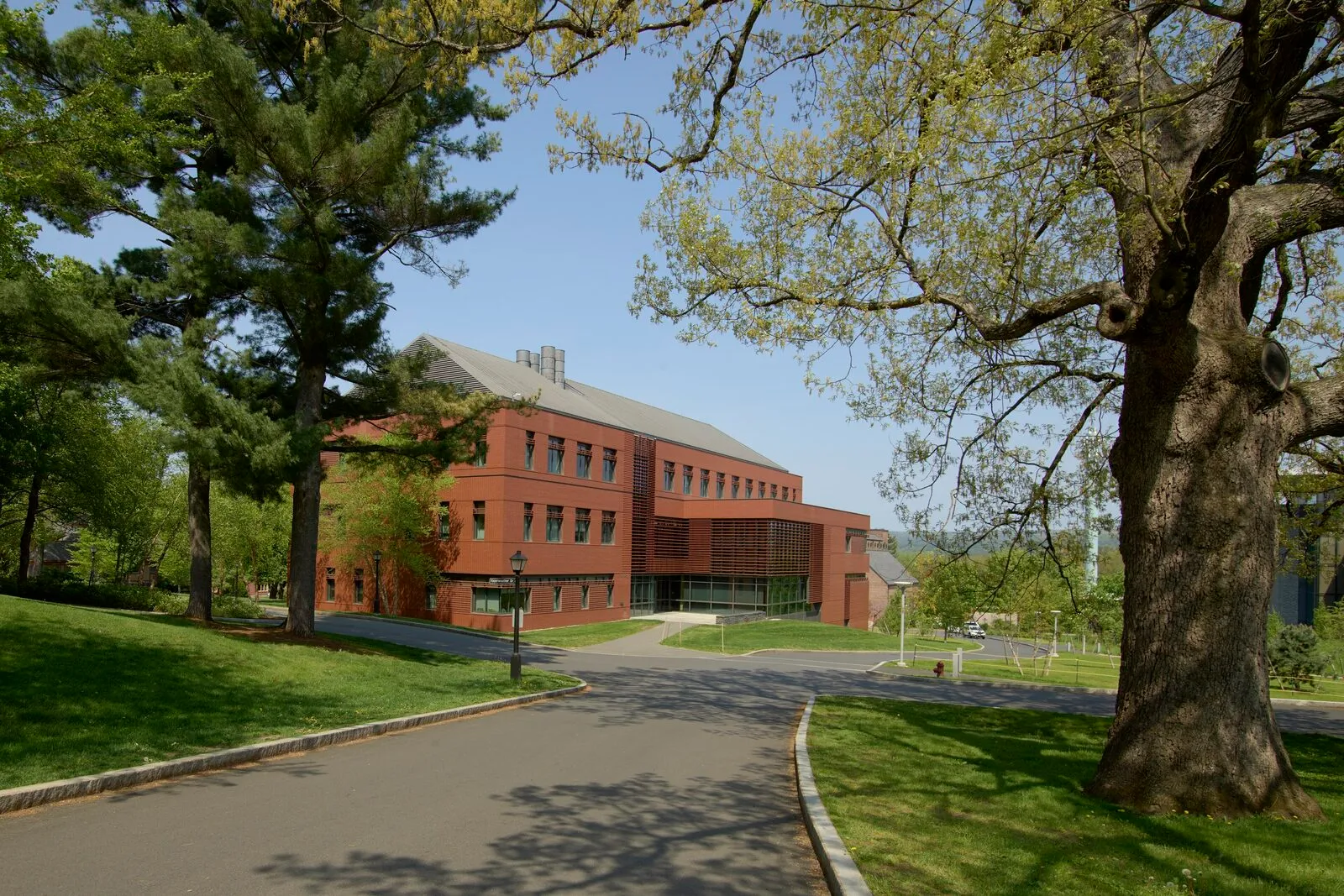
The Beneski Museum of Natural History is Amherst College’s teaching collection in the earth sciences, with about 200,000 specimens in storage and 1,700 on display across three open floors of the Beneski Earth Sciences Building, designed by Payette Associates and opened in 2006. It is one of the largest college natural history museums in the country and free for anyone to walk in.
What’s there
The galleries are organized by deep time: a timeline of fossils from Precambrian through the Pleistocene, paired with a strong mineral collection and a hall of articulated mammal skeletons. A mastodon uncovered in 1869 and a mammoth found in 1923 are the centerpiece of the upper floor.
The museum is best known for the Hitchcock Ichnological Cabinet, the world’s largest collection of dinosaur tracks: more than 1,700 sandstone slabs that the geologist and former Amherst College president Edward Hitchcock assembled in the 1830s and 1840s when the prints were still being interpreted as the footprints of giant prehistoric birds. The collection includes “Noah’s Raven,” the first dinosaur fossil ever collected in North America (1802).
Visiting
Admission is free and open to the public. The museum is generally open Tuesday through Friday, 10 AM-4 PM, and Saturday and Sunday, 10 AM-5 PM, and follows the college’s holiday calendar; check the website for current hours. Allow an hour to a comfortable half-day depending on interest. The building is steps from the Emily Dickinson Museum and the Mead Art Museum, so a single walk through central Amherst easily takes in all three.