In 1802, a twelve-year-old boy named Pliny Moody turned up an unusual sandstone slab while plowing his family’s field in South Hadley. The slab carried what looked like enormous bird tracks. A neighbor, Elihu Dwight, eventually bought it and gave the tracks a name out of the only large-bird vocabulary anyone had: Noah’s Raven.
It turned out to be the first dinosaur trackway recorded in North America, though the tracks were not identified as dinosaurian until decades later. Moody and Dwight had no way to know that: “dinosaur” wasn’t even a word until 1842. But the Connecticut Valley has been the most important early-Jurassic dinosaur-track site in the country, more or less continuously, ever since.
Why here
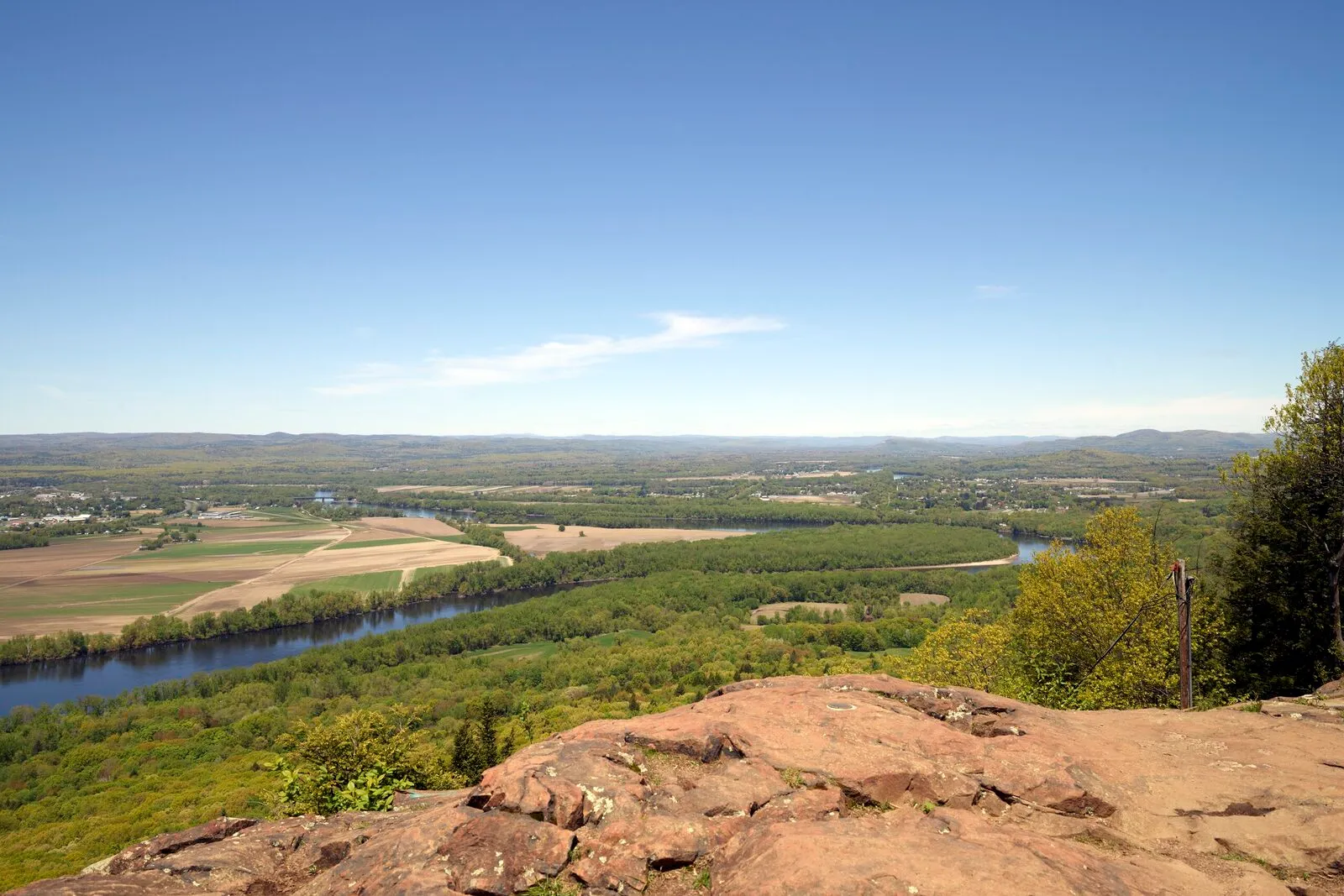
The geology cooperated. About 200 million years ago, near the start of the Jurassic, a long north–south rift valley opened across what is now central Connecticut and Massachusetts. The valley filled slowly with mud, sand, and basalt. The mud and sand preserved footprints made by the animals walking through, and the basalt, which is harder, capped the layers when faulting later tilted them on their side. Two hundred million years of erosion has stripped away the soft layers between the basalt caps, leaving the trap-rock ridges of the central Pioneer Valley standing up.
Mount Tom, the Holyoke Range, Mount Sugarloaf, and Mount Toby are all the same event.
Most of the dinosaur tracks turn up in the soft red sandstone (the Portland Formation) that fills the rest of the rift basin, particularly when sandstone is freshly exposed by a quarry, a construction site, or a plow. South Hadley sits on a thick band of exactly that.
Hitchcock and the giant birds
The slab Pliny Moody turned up eventually came to Edward Hitchcock, who was professor of natural history (and later president) at Amherst College from 1825 until his death in 1864. Hitchcock spent four decades collecting and cataloguing tracks from South Hadley, Turners Falls, Holyoke, and Greenfield. He named species (Eubrontes, Otozoum, Grallator) and he believed, with a certain unintentional prescience, that the tracks had been made by gigantic extinct birds. Modern paleontology has put the animals back in the dinosaur family but not far from where Hitchcock left them: most of the trackmakers were theropods, the same group that produced birds.
By the time Hitchcock died, his Ichnological Cabinet at Amherst College was the largest collection of dinosaur tracks anywhere. It still is.
Where to see them today
The collection now lives at the Beneski Museum of Natural History on the Amherst College campus, in Amherst. The Hitchcock Ichnological Cabinet wall, over 1,700 sandstone slabs (including Pliny Moody’s original Noah’s Raven), runs the length of one gallery and is the museum’s set piece. Admission is free.
Other places in the Valley where you can see dinosaur tracks in situ (in the rock, where the animals left them) are limited. Dinosaur Footprints, a small Trustees of Reservations site on Route 5 in Holyoke, has an exposed track surface along the Connecticut River. Dinosaur State Park in Rocky Hill, Connecticut (about an hour’s drive south) has a much larger covered track-bed under glass.
But for the deep dive, the Beneski is the place. Pliny Moody’s slab is in there, two centuries on, mounted on a wall and labeled as the oldest known dinosaur footprint discovered in North America, still in the Valley where the boy turned it up.