The Five College Consortium has linked the Pioneer Valley’s liberal-arts campuses since 1965: Smith in Northampton, Mount Holyoke in South Hadley, and Amherst, Hampshire, and UMass Amherst all in Amherst. The five campuses share library access, cross-registration, a dance department, and an inter-campus PVTA bus network. For a day visitor they share something more useful: a string of art museums, natural-history collections, gardens, and greens, all within a forty-minute drive of each other.
A single day won’t do justice to any one of them, but it can give you a working feel for what the consortium is: small old colleges and a big land-grant research university, all packed into the same river valley. This route runs roughly west-to-east, Smith to UMass, with a break in the middle for lunch in Amherst.
Morning: Smith College (Northampton)
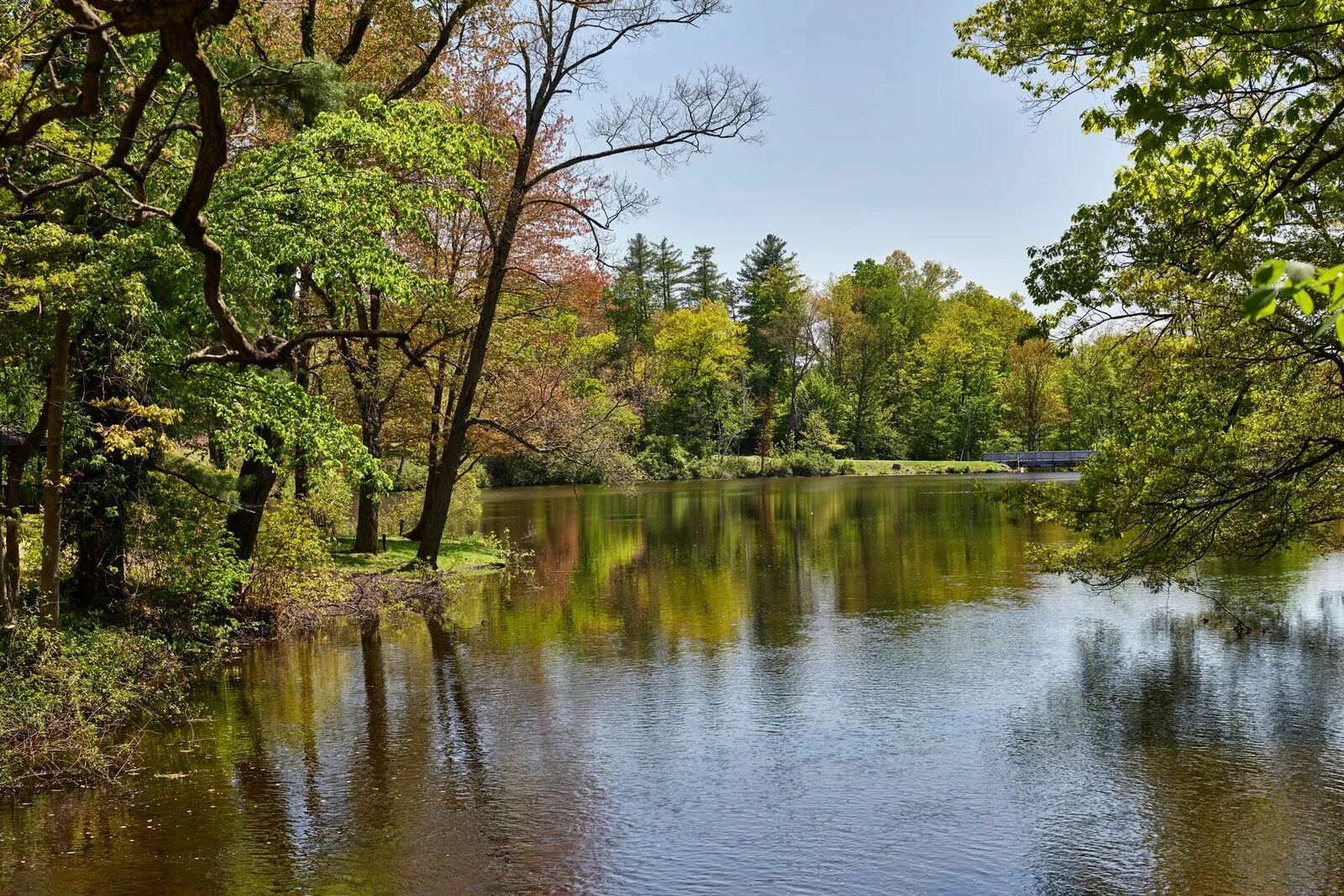
Start in Northampton. Smith’s campus runs along the west side of downtown, organized around the curve of Paradise Pond, an artificial lake on the Mill River that’s been the campus’s defining landscape feature since the 19th century. The quickest orientation is a loop around the pond and across the lower campus, ten minutes if you hurry, an hour if you don’t.
The Smith College Museum of Art is one of the strongest college collections in New England, with about 27,000 works of European, American, and Asian art, including a particularly deep 19th-century French and American collection. Free admission for the general public is the standard policy, though it’s worth checking hours before you go.
A few minutes’ walk away, the Smith College Botanic Garden wraps around the central campus. The Lyman Conservatory, a chain of glasshouses dating to 1895, is open free to the public most days and is at its showiest during the fall Mum Show and the spring Bulb Show. The outdoor arboretum runs through the whole campus, labeled and walkable.
Late Morning: Mount Holyoke College (South Hadley)
Drive south on Route 116 about twenty minutes to South Hadley. Mount Holyoke’s campus is arranged around two ponds (Lower Lake and Upper Lake), and the long sloping lawn of Skinner Green runs up to Mary Lyon Hall, the 1897 brick centerpiece. The campus is a National Historic Landmark and was laid out in part by the Olmsted firm.
The Mount Holyoke College Art Museum on lower campus is free, but is closed for renovation until fall 2026 for its 150th-anniversary reinstallation project. The Talcott Greenhouse next to it is small but lovely, with orchids, ferns, and seasonal plantings under glass. Free, generally open weekdays during the academic year.
If you have an extra half hour, walk the Upper Lake loop on the back side of campus. It’s wooded, quiet, and a useful counterweight to the manicured front lawn.
Lunch in Amherst
Drive east about fifteen minutes through Hadley to Amherst. The downtown is concentrated on a few short blocks of North and South Pleasant Street, with cafés, takeout, and sit-down restaurants, all walkable from the Common. Pick what looks good; most sit-down places are reliable.
Afternoon: Amherst College
The Mead Art Museum on the Amherst College campus is free and rewards a slow hour: a teaching collection running from antiquity to the present, with particularly good American and Mexican modernist holdings. A five-minute walk south brings you to the Beneski Museum of Natural History, whose Hitchcock Ichnological Cabinet is the largest collection of dinosaur tracks in the world, with about 1,700 sandstone slabs collected by Edward Hitchcock between 1836 and 1865. Three open floors include a mounted mastodon, a mammoth, and a deep-time fossil timeline. Free, generally Tuesday through Sunday.
If you want to slow down and spend a real afternoon on this stop alone, the Museum Day in Amherst guide covers the in-Amherst museums in more depth, including the Emily Dickinson Museum on Main Street and the Eric Carle Museum out by Hampshire College.
Late Afternoon: Hampshire College
Drive south on Route 116 about three miles to Hampshire College. Hampshire is the youngest of the five (chartered 1965, opened 1970) and the exception to the day’s pattern: there isn’t a major free public museum here. What there is, instead, is the Hampshire College Farm on the south end of campus, a working teaching farm with a small farm store, pastures, and walking paths.
Note (2026): Hampshire College announced its permanent closure in April 2026, ending after the Fall 2026 semester. The campus is in transition; some grounds and farm operations may continue under different stewardship, but public access is uncertain. Confirm current status before visiting.
The campus itself is built on former apple orchards, low and spread out, with woods, fields, and a small pond.
Evening: UMass Amherst
Head north to UMass Amherst, the consortium’s research university and by far its largest member, with about 25,000 undergraduates spread across a campus that dwarfs the other four combined. A quick walking circuit covers the most photogenic stops:
- The Old Chapel (1885), the oldest surviving academic building on campus. Restoration completed 2017 and a small landmark.
- The W.E.B. Du Bois Library, the tallest academic library building in the United States. The lobby and lower floors are generally open to visitors.
- The Fine Arts Center, a brutalist concrete arc on the south end of campus that holds the University Museum of Contemporary Art along with concert and theater venues.
- The Campus Pond, in the center of campus: the easy visual anchor, with the chapel and library both visible from its banks.
UMass also runs the Durfee Conservatory (greenhouses near the Stockbridge agricultural buildings) and a number of department collections that are open to the public on a more limited schedule. Hours and access shift; check before you go if there’s something specific you want to see.
Practical notes
- Driving is the easiest way to do all five in a day. Northampton to UMass is about thirty minutes without traffic, but the route is closer to two hours once you factor in parking and walking each campus.
- The PVTA Five College bus network connects the campuses and is a real option if you want to skip the parking hassle, though public fares and headways vary by route and academic calendar.
- Parking: Smith and Mount Holyoke have visitor lots near their museums; Amherst College has metered street parking on South Pleasant; UMass requires a visitor permit on weekdays (the Campus Center garage is the most reliable bet).
- Museum hours shift, especially around the academic calendar. Most college museums are closed Mondays, and several close for stretches between semesters and over winter break. Check before you drive.
- Realistically, pick three. Five campuses in a day is a real day, easier as a survey than as a deep dive. If a single museum or two campuses is what fits your schedule, the Museum Day in Amherst guide is the obvious fallback.