Palmer is a Hampden County town of about 12,400 in the eastern Pioneer Valley, set where the Quaboag, Ware, and Swift rivers come together to form the Chicopee River. The colonial settlement was first called the Elbow Tract (later Kingsfield) before it was renamed for John Palmer and incorporated as a town on August 23, 1775. It is bounded by Belchertown to the north, Ware to the northeast, Brimfield and Monson to the south, and Ludlow to the west.
Town of Seven Railroads
Palmer’s nickname, the “Town of Seven Railroads”, comes from the unusual number of rail lines that converged on the small town in the 19th century. Five of the seven actually operated: the Boston & Albany (the east–west main line, now CSX), the New London Northern (later the Central Vermont, now the New England Central; the north–south line), the Ware River Railroad, the Springfield, Athol & North-Eastern, and the Central Massachusetts. The Hampden Railroad was built but never carried regular traffic, and the Southern New England was graded but never finished. The Boston & Albany and the New London Northern crossed each other at grade in the village, and the Union Station described below was built by the two companies jointly to serve the interchange.
Union Station and the Steaming Tender
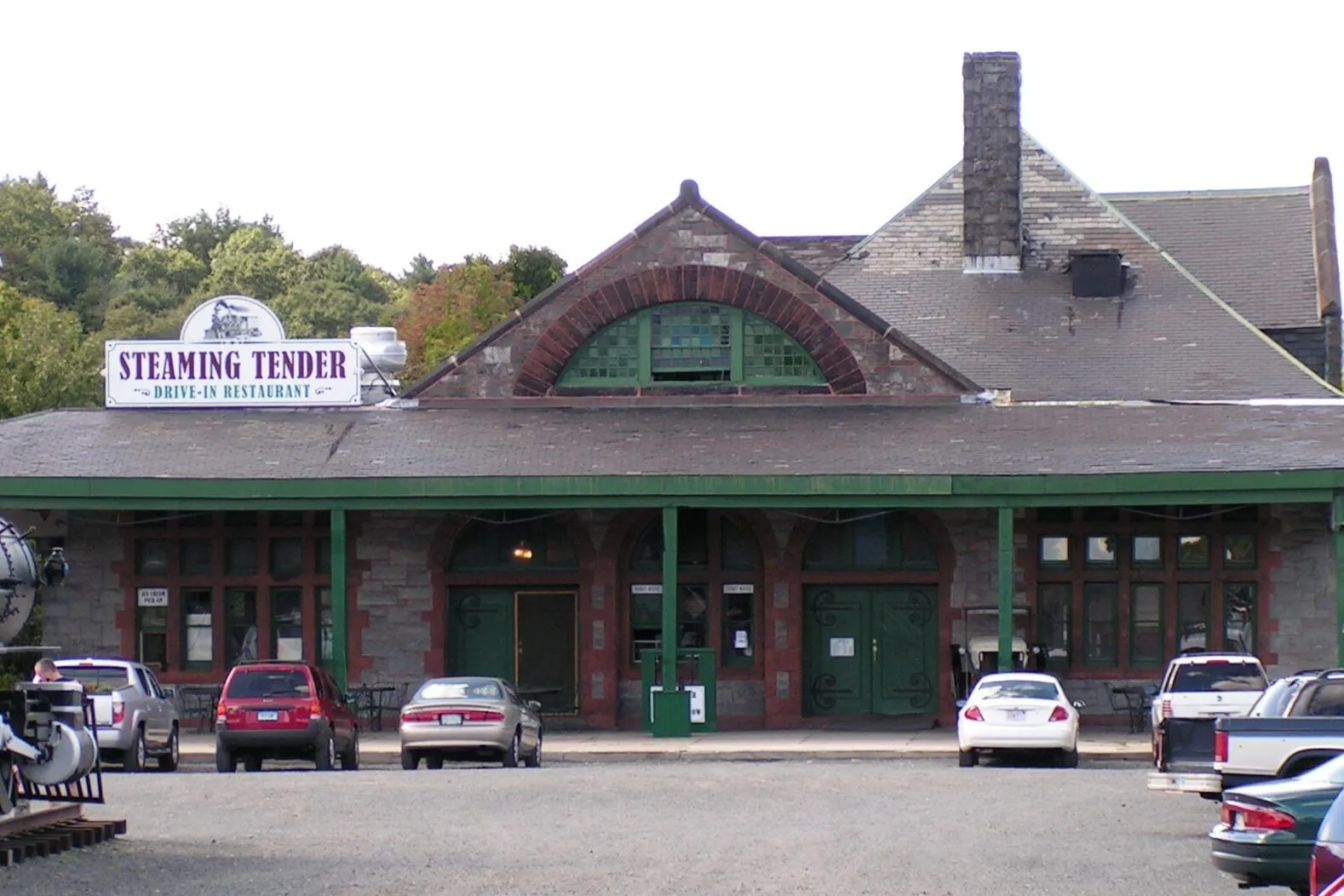
The hero image is Union Station at 28 Depot Street, designed by Henry Hobson Richardson (with the stoneworking firm W. N. Flynt & Company), construction begun in May 1883, and opened in June 1884. It is a small, characteristically Richardsonian depot in rusticated stone with a deep sheltering porch, heavy round-arched openings, and a broad sweeping roof, one of the last buildings Richardson designed before his death in 1886. Passenger service through the station ended in 1971 when Amtrak took over intercity rail; the building sat unused for decades, was added to the National Register of Historic Places in 1988, and reopened in 2004 as the Steaming Tender Restaurant, with a small collection of railroad equipment parked alongside. The Boston & Albany main line still runs along the back of the building and freight trains pass within feet of the dining room.
The four villages
Like several other Pioneer Valley mill towns, Palmer is a single municipality made up of four distinct villages, each with its own 19th-century industrial history:
- Palmer Center (also called Depot Village) is the village around Union Station and the Boston & Albany line: the civic center, with the town hall, the library, and most of the downtown storefronts.
- Three Rivers sits at the confluence of the Ware and Quaboag rivers that forms the Chicopee. The village takes its name from the meeting of the waters. (The Swift joins the Ware just upstream of the village.) It had a 19th-century textile and paper-mill complex on the river.
- Bondsville, on the Swift River, grew up around a textile mill founded by Emelius Bond in the 1820s; the Boston Duck Company ran the mill from the late 19th century until 1941, producing heavy cotton duck cloth (including raincoat fabric) and the rows of mill housing along the river date from that era.
- Thorndike is the small fourth village in the western part of town, also a 19th-century mill village.
Other notes
- The Quaboag River runs east-to-west across the town, joining the Ware (which has come down through Three Rivers from the north) just below Three Rivers village to form the Chicopee. The Chicopee then flows west through Ludlow toward the Connecticut.
- Palmer voters approved a casino proposal in a 2010 referendum, but the project for a destination casino on the east edge of town was rejected by Massachusetts gaming regulators in 2014; the site was never developed.
- The Quaboag Connector and other regional transit links connect Palmer to Springfield and Ware. There has been long-running advocacy for restored Amtrak passenger service to Union Station on the Boston-to-Albany line, but as of recent years no station stop has been added.