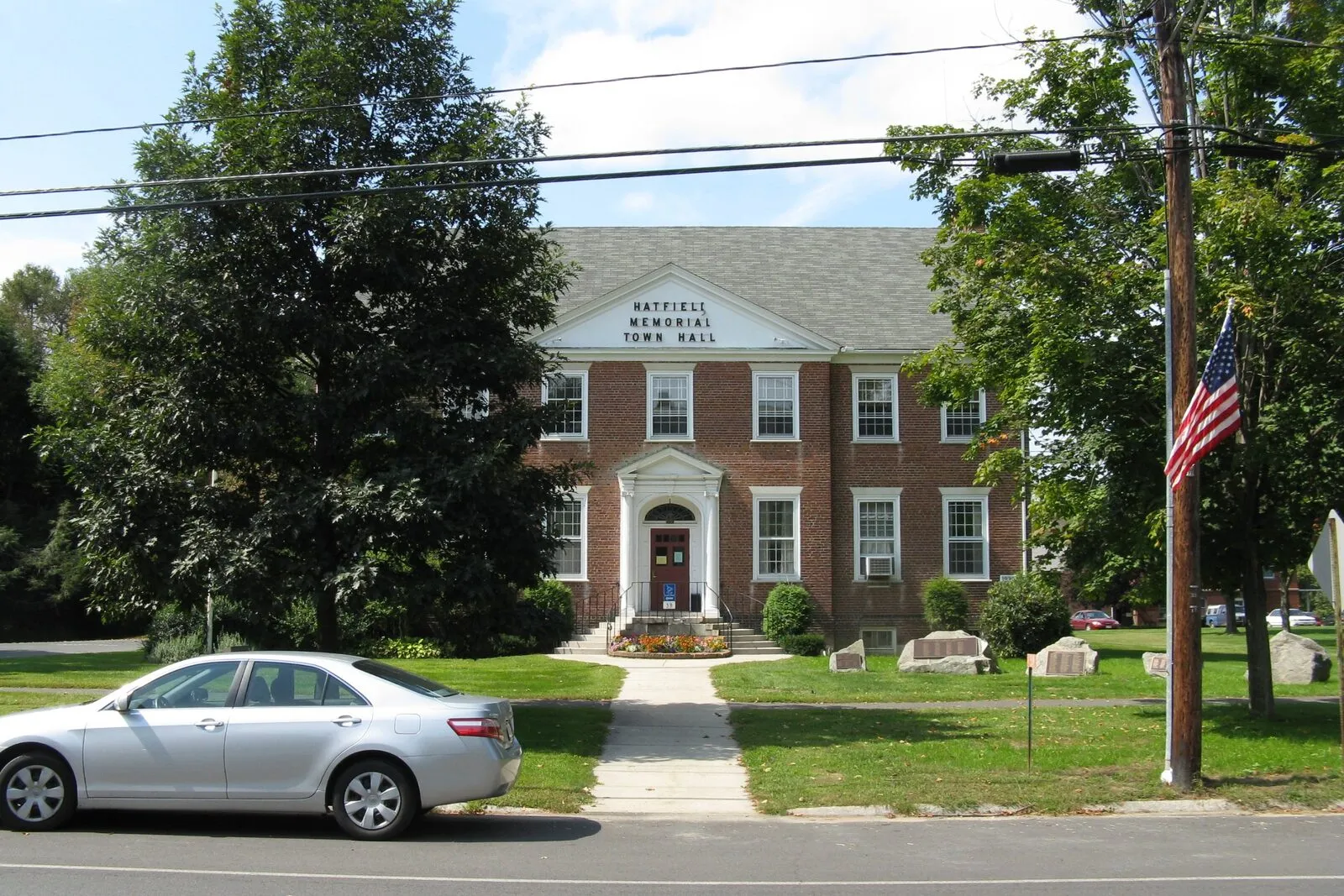
Hatfield is a small Hampshire County town of about 3,300 on the west bank of the Connecticut River, between Northampton to the south and Sunderland across the river to the northeast. The town was set off from Hadley in 1670, four years after Hadley itself was incorporated, and is one of the oldest English settlements in the Valley.
Farm country
Most of Hatfield is flat alluvial bottom-land, the same Hadley loam that made the river-bottom Hampshire towns the most productive agricultural ground in New England, and most of that flat ground is still in active agricultural production. Hatfield, Whately, and Hadley together form the heart of the Valley’s surviving tobacco-and-asparagus belt. The tall, slatted shade-tobacco barns scattered along the back roads are the most visible legacy of the early-20th-century shade-tobacco industry; production has shrunk from thousands of acres to a few dozen, but a handful of Hatfield farms still grow it. The town is also a major asparagus producer, and the Hatfield Asparagus Festival in May or June draws Valley residents into the farm fields.
The historic center
The Main Street neighborhood, running parallel to the river just inland, has the densest concentration of old houses in the town: Federal, Greek Revival, and Italianate clapboard houses along an unusually wide and tree-shaded right-of-way, with the Hatfield Memorial Town Hall (above) and the First Congregational Church anchoring the village center.
The town was the site of one of the more notable engagements of King Philip’s War: the Raid on Hatfield in October 1675, in which Native forces attacked the village, burned barns, and killed several colonists; sources disagree on the exact day. A later raid on September 19, 1677, after the war had officially ended, took some Hatfield residents captive.
Sophia Smith and Smith College
Hatfield is the birthplace of Sophia Smith (1796–1870), whose late-life bequest founded Smith College in Northampton. Smith was the eldest of four daughters of a Hatfield farm family; she became deaf at 40, lived quietly in town for the rest of her life, and inherited a substantial fortune from her brother Austin in 1861. Her 1870 will left over $387,000 to charter and endow a women’s college, with a final revision specifying Northampton (not Hatfield) as the location. Smith College was chartered in 1871 and opened in 1875.
In her will Smith also funded Smith Academy in Hatfield as a local secondary school, opened in 1872 and still operating today as the town’s combined middle and high school. Her grave in the Main Street Cemetery, alongside her brother Austin and sister Harriet, carries the inscription “She founded Smith College in Northampton and Smith Academy in Hatfield.”
Other notes
- Smith Academy, in the village, is the town’s public middle and high school, one of the smallest in Massachusetts, with around 130 students. It is the institution Sophia Smith funded in her 1870 will (see above) and is now public.
- The Mill River forms the southern boundary with Northampton and runs through the center of town to the Connecticut.
- A long-standing American elm on Main Street is well-known locally as one of the largest surviving elms of its generation in Massachusetts and has its own substantial photographic record.
Sources
- Town of Hatfield
- Hatfield, Massachusetts — Wikipedia (2020 U.S. Census population: 3,352)
- Sophia Smith — Wikipedia