Hampden is a small Hampden County town of about 5,100 in the wooded hills southeast of Springfield, set between Wilbraham to the north, East Longmeadow to the northwest, Monson to the east, and the Connecticut state line to the south. The town began as the South Parish of Wilbraham, the hill-country half of that town, separated by Minnechaug Mountain from the Wilbraham village to the north, and was set off and incorporated as the Town of Hampden in 1878, taking its name from the surrounding county.
Thornton W. Burgess and Laughing Brook
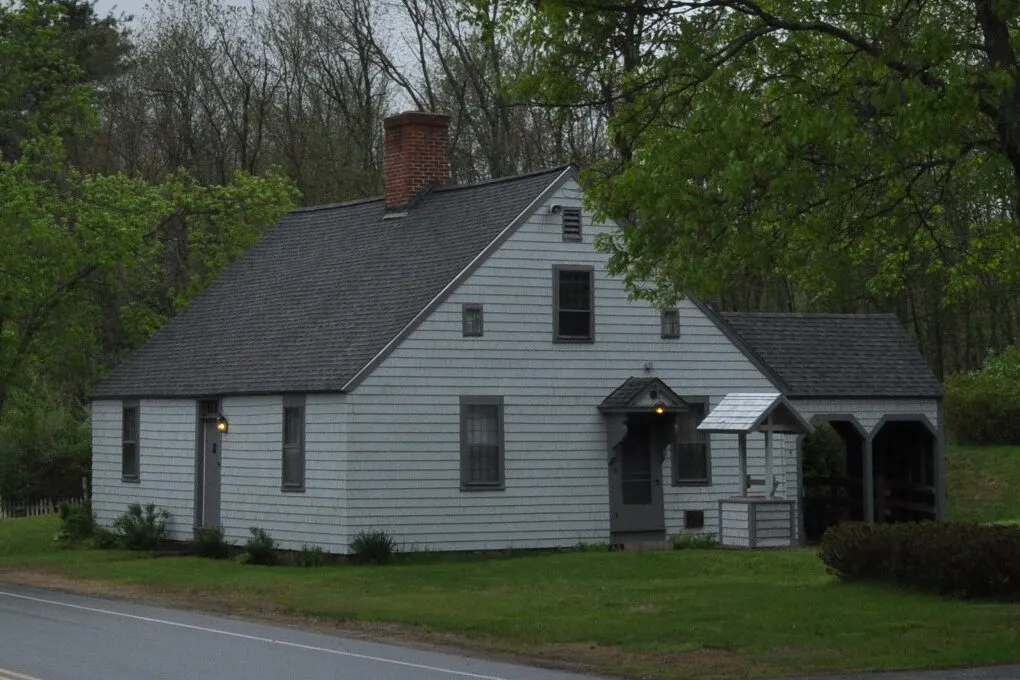
The single name most associated with Hampden is that of Thornton W. Burgess (1874–1965), the prolific Massachusetts-born children’s-book author of the Old Mother West Wind stories, Peter Cottontail, Reddy Fox, Jimmy Skunk, and dozens of other animal tales that ran in American newspapers and children’s books from 1910 into the 1960s. Burgess bought a small farmhouse on Main Street in Hampden in 1925 and lived and wrote there for the next thirty-plus years. The house and the brook behind it, which he nicknamed “Laughing Brook”, became the literal setting for many of the Old Mother West Wind tales, and the wooded hillside above the brook is the Green Forest of the books.
After Burgess’s death the homestead and surrounding woods passed to the Massachusetts Audubon Society, which opened it as the Laughing Brook Wildlife Sanctuary in 1967. The sanctuary covers roughly 350 acres of brook, woods, and hill, with several miles of free-walking trails (the historic Burgess House and adjoining education buildings are not always open to the public, but the trails are open dawn to dusk). The sanctuary is the single largest visitor draw the town has.
Minnechaug Mountain and the Scantic
Hampden sits in the southern Wilbraham–Hampden hill country. The northern border of the town runs along the ridgeline of Minnechaug Mountain, the long north–south trap-rock ridge that separates the town from Wilbraham; the Scantic River runs west across the southern end of town on its way through East Longmeadow and into Connecticut, and a network of small brooks (Laughing Brook, Temple Brook, and Glendale Brook among them) drain the central uplands. The town remains heavily wooded, with a quiet two-lane road network and almost no through traffic.
Town center
The historic town center sits on Main Street near the Laughing Brook trailhead, around the small Town House (the 19th-century town hall, still in municipal use), the Hampden Free Library, and the Hampden Historical Society in the old Academy building. There is no village business district to speak of. Most everyday shopping happens in East Longmeadow or Wilbraham, and the town has the feel of a half-rural, half-residential bedroom community for the Springfield metro south of it.
Sources
- Town of Hampden
- Hampden, Massachusetts — Wikipedia (2020 U.S. Census population: 5,135)
- Thornton Burgess — Wikipedia
- Laughing Brook Wildlife Sanctuary — Mass Audubon