East Longmeadow is a Hampden County town of about 16,400 immediately east of Springfield and north of the Connecticut state line. The town began as the East Village of old Longmeadow, the higher-ground, industrial half of that town, built up around the red-sandstone quarries that ran across its uplands. It split off as a separate town when it incorporated in 1894, leaving the river-leaning residential half behind as Longmeadow proper.
The brownstone era
Through the second half of the 19th century, East Longmeadow’s hills held something close to a hundred small red-sandstone quarries at the industry’s peak. The local stone, a fine, even-grained Triassic sandstone, became known to the trade simply as “Longmeadow brownstone” (the East Longmeadow name post-dates the quarries’ heyday) and was shipped out by rail once a branch line reached the town in the mid-1870s.
The most prominent users were the Norcross Brothers of Worcester, who owned several of the East Longmeadow pits and introduced Longmeadow brownstone into the most-celebrated work of their era, most famously the trim and dressed stone of Trinity Church on Copley Square in Boston (Henry Hobson Richardson, completed 1877), where Longmeadow brownstone is the warm reddish- brown counterpoint to the church’s Milford granite walls. The stone went into many other public buildings and into the brownstone-front rowhouses that gave the late-19th-century Northeast city its informal name. The industry brought Swedish, French, and Italian immigrant labor into the town and gave it the ethnic mix it still has.
By the 1910s and 1920s the brownstone era was essentially over; fashion shifted to lighter limestone and brick, and most of the quarries were abandoned. A few of the old pits remain visible (some flooded, some on private land) across the eastern part of town.
The seven-street rotary
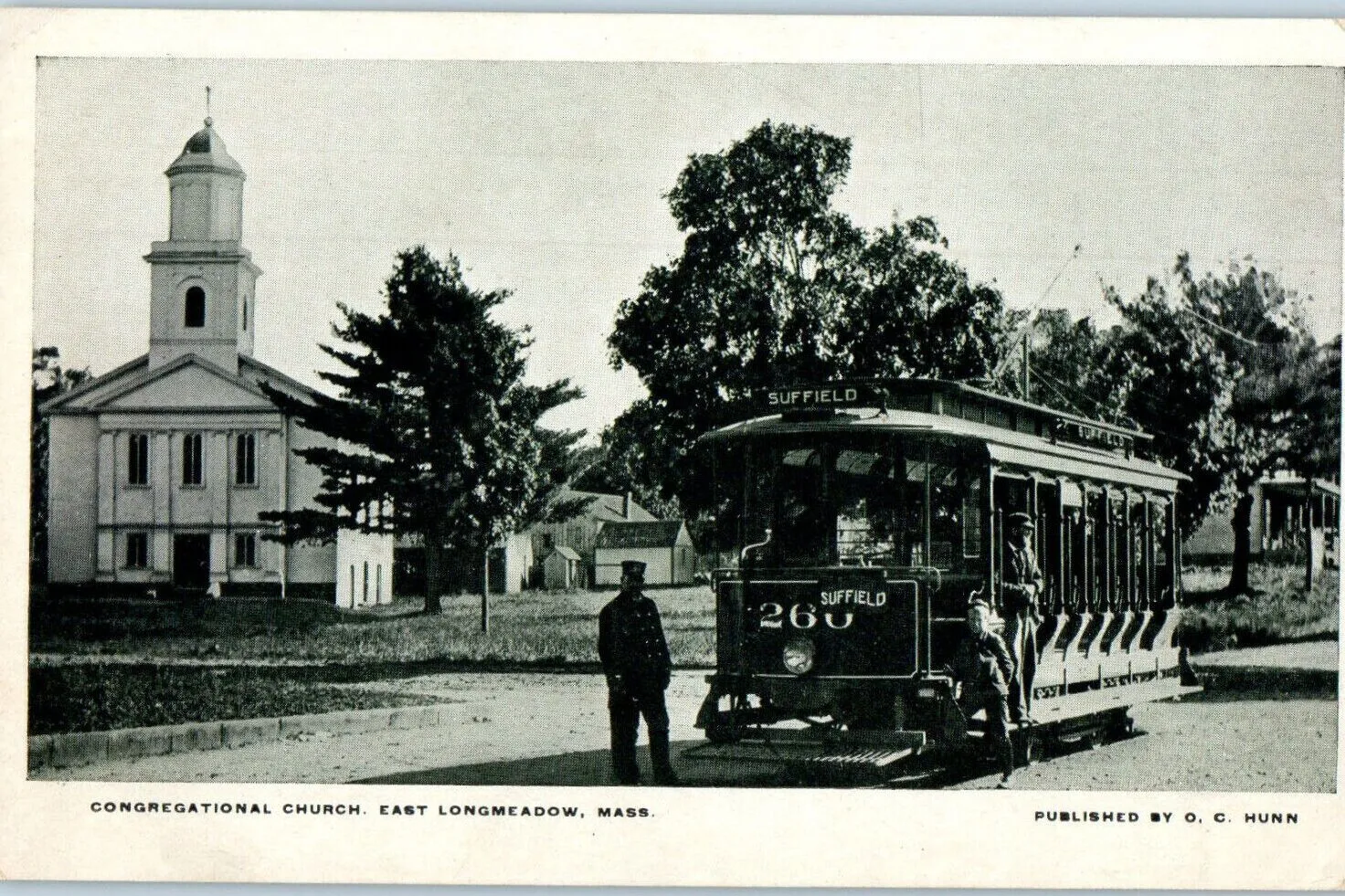
The center of East Longmeadow is Center Square, the rotary where seven streets (Maple, Shaker, Prospect, Somers, Pleasant, Elm, and North Main) converge. The intersection was famous enough in its early-20th-century form (no traffic lights, seven entries) to appear in Ripley’s Believe It or Not!, and it still anchors the town’s civic and commercial fabric. The Town Hall, the historic First Congregational Church (rebuilt several times, the version pictured above is the early-20th-century rebuild seen from the rotary), the post office, and most of the small downtown storefronts all front on it.
Milton Bradley
The largest single private employer through most of the late 20th century was the Milton Bradley game manufacturing plant on Shaker Road. Milton Bradley was founded in 1860 in Springfield as a small lithography shop and grew into the country’s largest board-game maker; the company built its 1.1-million-square-foot East Longmeadow plant in the late 1960s to consolidate manufacturing, and continued to run it through the Hasbro acquisition of 1984. In 2015 the East Longmeadow facility was sold to the Belgian games-and-cards manufacturer Cartamundi, which still prints and boxes the Milton Bradley and Hasbro lines under its new ownership.
Other notes
- The town is bounded by Springfield on the north and northwest, Longmeadow on the west, and the Connecticut towns of Enfield and Somers to the south, with Hampden to the east and Wilbraham to the northeast.
- The streetcar in the postcard ran the Springfield Street Railway’s line south from Springfield through East Longmeadow to Suffield, Connecticut in the early 1900s, one of the short-lived interurban routes that stitched the Hampden-county villages together before the line was abandoned in the 1920s.
Sources
- Town of East Longmeadow
- East Longmeadow, Massachusetts — Wikipedia (2020 U.S. Census population: 16,430)
- Trinity Church (Boston) — Wikipedia
- Norcross Brothers — Worcester — Brickfrog blog