Conway is a small Franklin County hill town of about 1,800, set in the broken country between the Deerfield River to the north (which forms part of its boundary with Shelburne) and the upland sources of the South River and the Mill River to the south. It was settled in 1762 and incorporated as a town in 1767. There are three loose village clusters (Conway Center in the middle of town, Burkeville in the east near the South River, and the South Part along the Williamsburg line), but most of the town is woods, hill farms, and old stone walls.
The Field Memorial Library
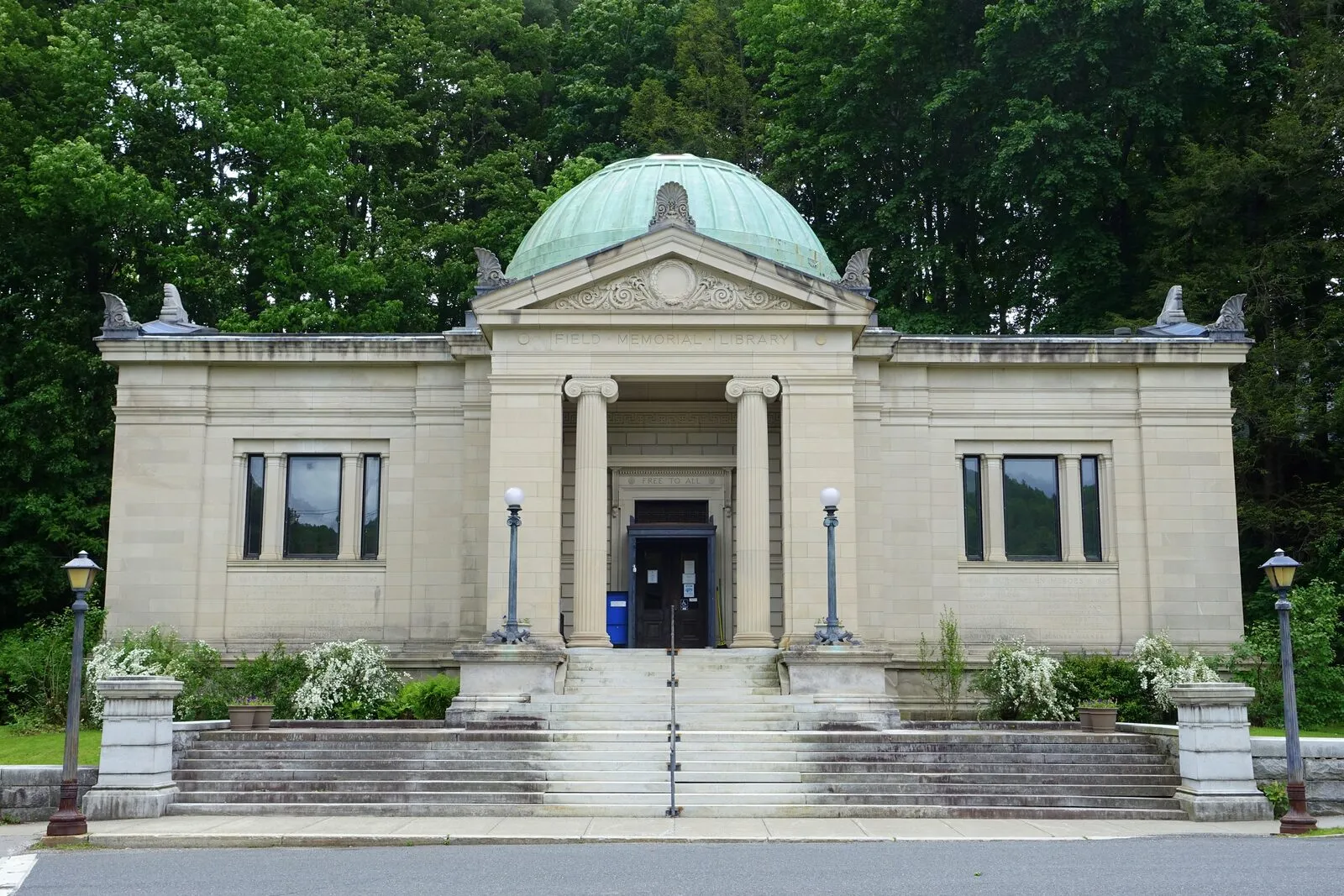
The town has a monumental civic building wildly out of scale with its population: the Field Memorial Library (pictured), a Beaux-Arts limestone library with a copper-domed central rotunda, designed by the prominent Boston firm Shepley, Rutan & Coolidge and completed in 1901. The library was a gift to Conway from Marshall Field, the Chicago department-store magnate who was born and raised in Conway and dedicated the building to the memory of his parents, John and Fidelia Field. Inside there is Italian marble, a spiral staircase, original woodwork, and cast-iron book-stack shelving that has not been replaced. It still operates as the town’s public library and is the visual center of Conway Center.
Marshall Field
Marshall Field (1834–1906) was born on August 18, 1834, on a farm in Conway, the third of six children. He left at 17 for a dry-goods job in Pittsfield, moved on to Chicago at 22, and built Marshall Field and Company into one of the largest department- store operations in the United States. The two visible Conway artifacts of his career are the library above and the Field family plot in the town cemetery. He never moved back, but the town and his namesake foundation still maintain ties to his family.
Burkeville Covered Bridge
The eastern end of town has the Burkeville Covered Bridge over the South River, in the small former mill village of Burkeville. The current bridge was built in 1870 to replace an 1850 bridge washed out in a flood the year before. Structurally it is a modified Howe truss with iron tensioning verticals (believed to be the oldest surviving timber-and-iron-combination truss in Massachusetts), and is one of the few 19th-century covered bridges left in the state. The roof partially collapsed under heavy snow in 1975, the bridge was closed in 1985 for safety, and after a long rehabilitation it reopened to one-lane vehicular traffic in November 2013. Listed on the National Register since 1988.
Bardwell’s Ferry Bridge
The 1882 wrought-iron lenticular truss Bardwell’s Ferry Bridge spans the Deerfield River on the Conway–Shelburne line in the northeast corner of Conway. It is the more dramatic of the town’s two historic bridges and is featured on the Shelburne entry’s hero image; from the Conway side, the access is via Bardwell’s Ferry Road.
Other notes
- The poet Archibald MacLeish (1892–1982), three-time Pulitzer winner and a Librarian of Congress, kept a long-term home in Conway from the 1920s on, on a hill farm called Uphill Farm, and is buried in the town cemetery.
- The Conway Common in the village center has the town hall, the Congregational church, and the Field Memorial Library all within a short walk.
- Route 116 is the main through-road, climbing from Deerfield in the east up through Conway to Shelburne Falls and the Mohawk Trail.
Sources
- Town of Conway
- Conway, Massachusetts — Wikipedia (2020 U.S. Census population: 1,761)
- Field Memorial Library
- Burkeville Covered Bridge — Wikipedia