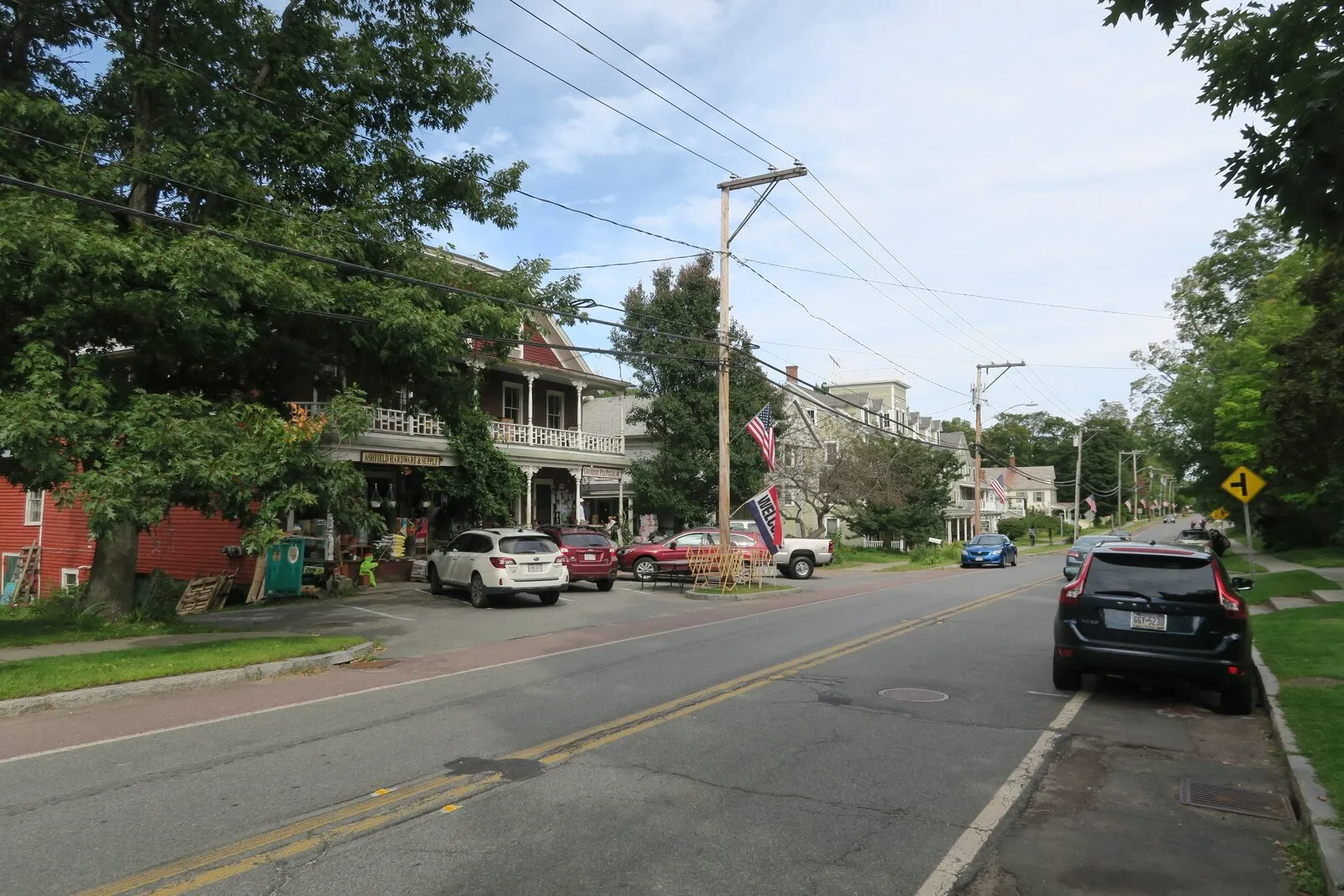
Ashfield is a small Franklin County hill town of about 1,700 in the southwest corner of the county, in the upland country between the Deerfield and Westfield river drainages. The town was first settled in the 1740s under the provisional name Huntstown (for Captain Ephraim Hunt, whose heirs held the original grant) and was incorporated as Ashfield on June 21, 1765. It is bounded by Buckland to the north, Conway to the east, Williamsburg to the southeast, Goshen to the south, Cummington to the southwest, Plainfield to the west, and Hawley to the northwest.
Ashfield Plain
The village center, known as Ashfield Plain, runs along Main Street (Route 116) at the east end of Ashfield Lake. The pictured streetscape is the heart of it: a tight row of 19th-century clapboard storefronts and porch-fronted commercial blocks, the white-spired Ashfield Town Hall (a former Congregational meetinghouse; see below), the brick Belding Memorial Library, the St. John’s Episcopal Church, and a short walk down to the lake. The Plain is listed on the National Register as the Ashfield Plain Historic District.
Town Hall
The Ashfield Town Hall on Main Street is a tall white-clapboard former meetinghouse with a three-tiered spire. It was built in 1812 as the First Congregational Church, originally on Norton Hill Road south of the village; it was moved down to the Plain in 1857 after a second Congregational building was put up nearby. When the two Congregational societies merged in 1870 and built a new shared church across the street, the older building was sold to the town and converted into the town hall, the use it still serves today.
Ashfield Lake
Ashfield Lake is a roughly 37-acre spring-fed pond at the west edge of Ashfield Plain, with its long axis pointing southwest toward Route 112. The town runs a small town beach and Belding Memorial Park on the north shore, off Main Street, with a lifeguarded swimming area, picnic tables, and a public boat launch (canoes, kayaks, small craft). Use of the swimming beach is restricted to town residents in summer; the boat launch and park are open to the public. The lake is the visible center of Ashfield’s summer life and is the reason much of the village grew up where it did.
Charles Eliot Norton
Ashfield’s most-cited summer resident was Charles Eliot Norton (1827–1908), Harvard’s first professor of art history, founding editor of the North American Review, and the close friend and American literary executor of John Ruskin. Norton bought a hill farm in Ashfield in 1864 and spent nearly every summer here for the rest of his life, retreating from his year-round home (also called Shady Hill) in Cambridge.
From 1879 to 1903, Norton and the writer George William Curtis organized the Ashfield Dinners, an annual late-summer public banquet held in the town hall to raise money for the local Sanderson Academy. Speakers over the dinners’ twenty-four-year run included William James, Josiah Royce, James Russell Lowell, William Dean Howells, and Booker T. Washington. For its size and remoteness, late-19th-century Ashfield ran one of the more remarkable visiting-lecturer rosters in New England.
Other notes
- The Ashfield Fall Festival, held on the village green and along Main Street on Columbus Day weekend in October, dates to 1970 and is the town’s signature annual event, with a juried craft fair, food booths, music, and a parade. It is sometimes informally called the Ashfield Fair, but the older 19th-century Ashfield agricultural fair tradition is no longer continuous; the modern festival is its successor.
- Chapel Brook, in the southwest corner of town, drops over a series of ledges in the Chapel Brook Reservation, a small Trustees of Reservations property with a short walk to the falls and the rock outcrop known as Pony Mountain.
- The Belding Memorial Library, on Main Street, was given to the town in 1913 by the silk manufacturer Milo M. Belding, whose family had Ashfield roots.
- Notable people born or raised in Ashfield include the astronomer and lens-maker Alvan Clark (1804–1887), the first president of the Sapporo Agricultural College and third president of the Massachusetts Agricultural College William S. Clark (1826–1886), and the filmmaker Cecil B. DeMille (1881–1959), whose family kept a summer home here.
Sources
- Town of Ashfield
- Ashfield, Massachusetts — Wikipedia (2020 U.S. Census population: 1,695)
- Ashfield Plain Historic District — Wikipedia
- Charles Eliot Norton — Wikipedia
- Ashfield Lake — Town of Ashfield