Williamsburg is a small Hampshire County hill town of about 2,500 in the Mill River valley, west of Northampton and east of the Berkshire foothills. The town sits at the headwaters of the Mill River, where its East and West branches meet, and its history runs almost entirely through the river. The river powered a chain of small 19th-century mill villages along the banks, and one catastrophic 1874 morning the river also destroyed them.
The villages
The town is functionally a string of village clusters along the Mill River, set out from upstream to down:
- Williamsburg village, the main town center, around the meeting of the East and West branches. The 1850s Williamsburg General Store, the Meekins Public Library (1900), the Old Town Hall, and the First Congregational Church are here.
- Skinnerville, once a small mill village a mile downstream, built around silk-manufacturer William Skinner’s mills. Almost entirely destroyed in the 1874 flood and never rebuilt at scale; Skinner relocated his works to Holyoke.
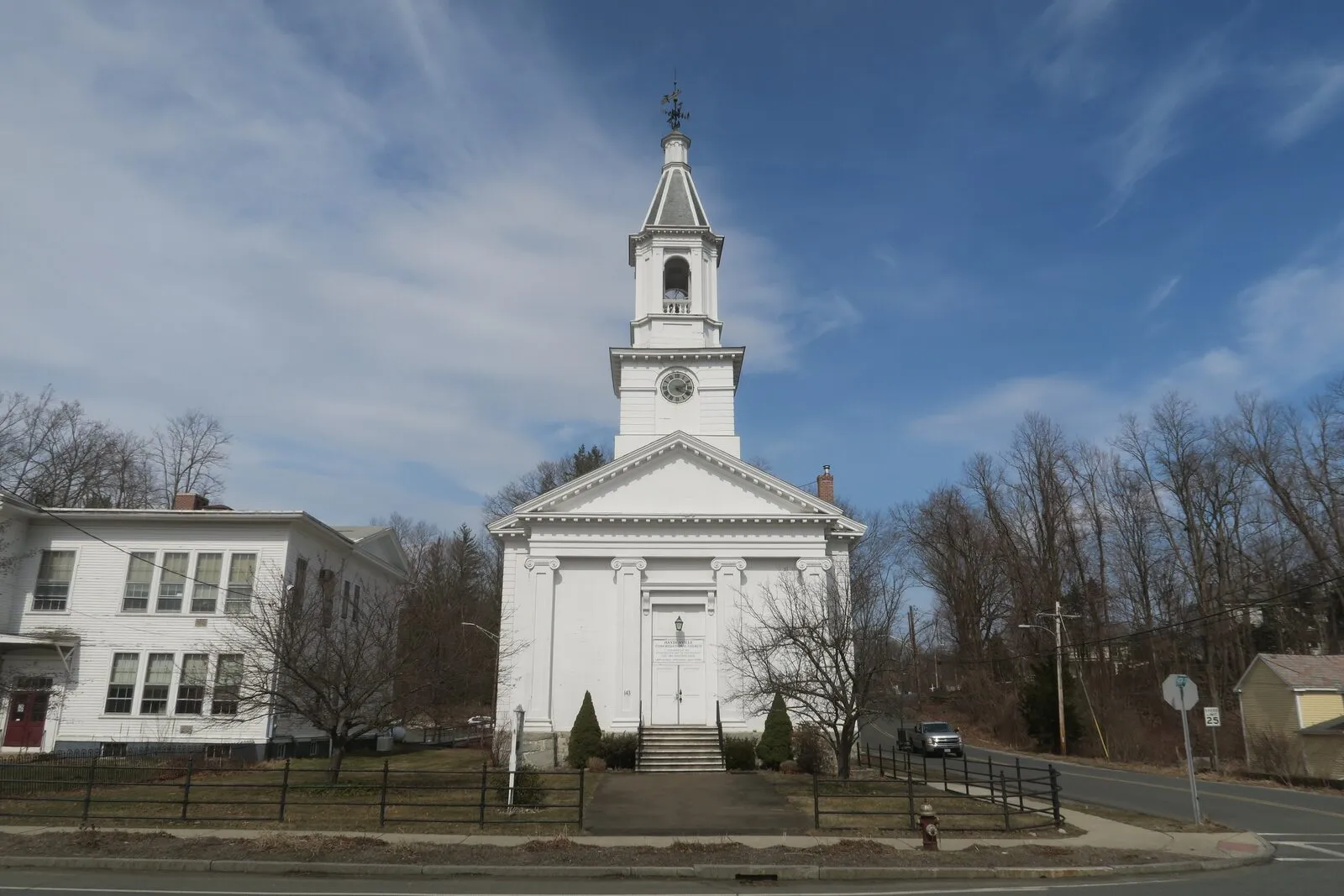
- Haydenville, the largest of the surviving villages, around the Hayden family’s 19th-century brass-works complex. The Italianate Haydenville Congregational Church above (1852, built with Hayden family funds) still stands at the village center.
- Searsville, a smaller manufacturing settlement on a tributary at the western edge of town.
The downstream end of the Mill River chain (Leeds and Florence in Northampton) is part of that town.
The 1874 Mill River disaster
On the morning of Saturday, May 16, 1874, the Williamsburg Reservoir Dam in the hills west of the village failed catastrophically. The earthen dam, completed in 1866 by a consortium of Mill River industrialists led by Joel Hayden Sr., released about 2,000 acre-feet of water down the narrow valley in something close to an hour. 139 people died in Williamsburg village, Skinnerville, Haydenville, and Leeds (in Northampton). The factories along the river were largely destroyed; some (including the William Skinner silk operation) were rebuilt elsewhere; some were not rebuilt at all.
The dam failure was the first major dam disaster in U.S. history and led directly to the country’s first dam-safety legislation. The dam keeper, George Cheney, who saw the dam beginning to fail and rode his horse downstream to warn the villages below, saved an unknown but probably substantial number of lives in the process; modern markers along the Mill River trace the route he rode.
The Haydens
The hero church is the most visible reminder of the Hayden family, whose brass works in Haydenville was the largest single employer in 19th-century Williamsburg. Joel Hayden Sr. (1798–1873), the senior partner, was also the 26th Lieutenant Governor of Massachusetts (1863–1866) and bankrolled much of Haydenville’s institutional fabric: the 1852 church, the worker housing along High Street, and the 1900 Hayden Memorial Library that the family endowed after the brass works closed. Hayden died several months before the 1874 flood destroyed the four factories he had built; the brass works were rebuilt and ran into the early 20th century before closing for good.
Today
Williamsburg today is a quiet residential town with a small working-farm presence, several light-manufacturing employers in Haydenville, and a steady tourist trade through the Williamsburg General Store on Route 9, halfway between Northampton and the Berkshire hills. The Mill River has been intentionally kept unobtrusive (the modern reservoirs that once filled the 1860s-built dams are no longer in storage use), and the river runs clean through the village again.