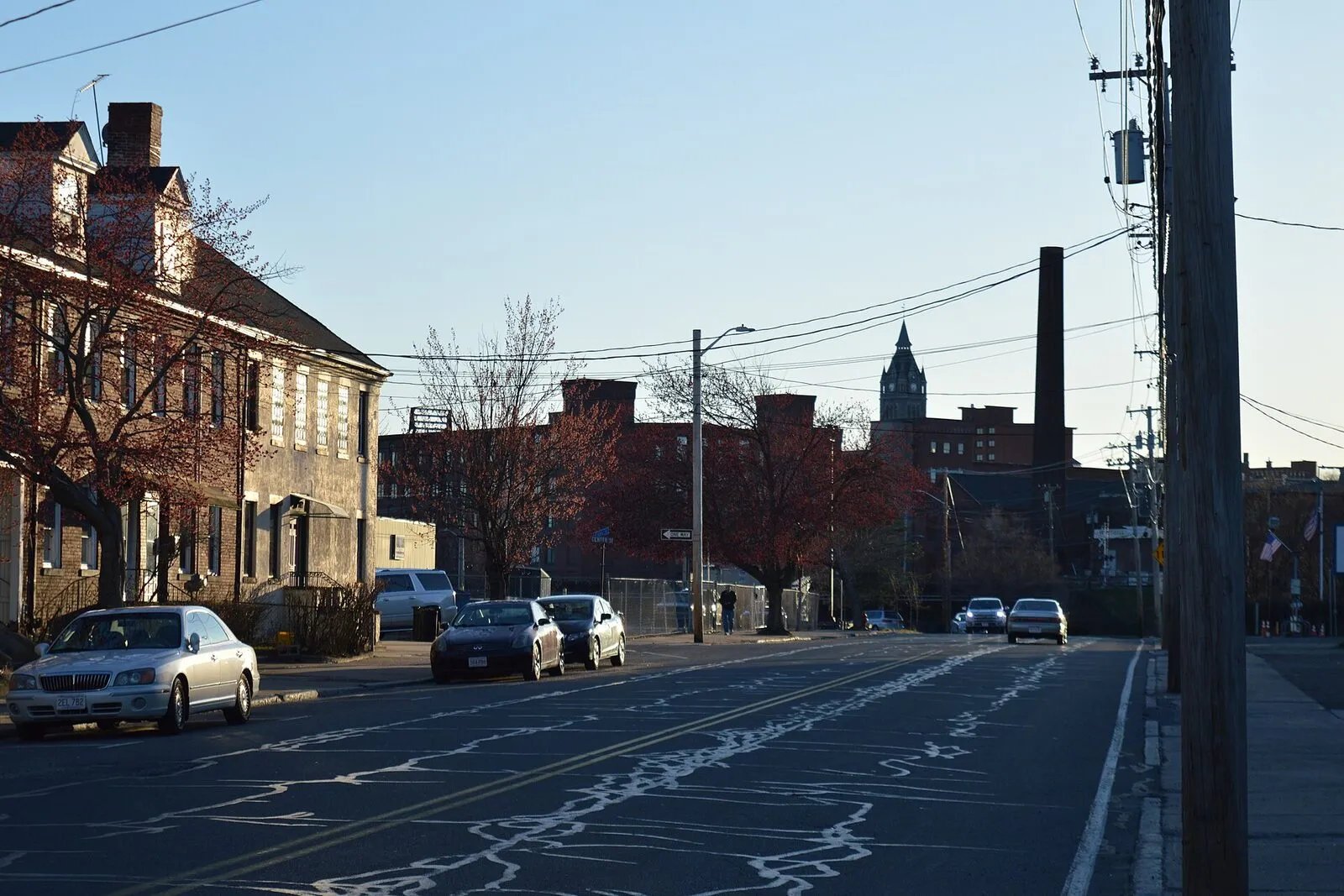
Holyoke is the only large city in the Connecticut Valley that was actually planned: laid out from scratch in the 1840s by the Hadley Falls Company around a three-tiered canal system that powered first textile mills and then, by the late 19th century, paper. The city’s industrial high point gave it the Skinner silk fortune, the Volleyball Hall of Fame (the sport was invented at the Holyoke YMCA in 1895), and an unusually concentrated mill-and-canal architectural inheritance. A day in Holyoke takes in all of that and finishes on the traprock ridge of Mount Tom above the city.
Morning: The Heritage State Park canal walk
Park downtown near the second-level canal (Holyoke is built across three stepped canals that drop water about sixty feet from the river to the mills) and walk along the canal-side path of Holyoke Heritage State Park. The Heritage Park campus runs along restored 19th-century mill buildings and includes a small visitor’s center with exhibits on the city’s industrial history. The pace here is slow on foot; the canal-side block is one of the few stretches in the Valley where the planned-city geometry of mill, canal, and rowhouse is still legible at full scale.
The campus also includes the Holyoke Merry-Go-Round, a restored 1929 Philadelphia Toboggan Company carousel that ran for decades at the now-closed Mountain Park amusement park on Mount Tom and was rescued and re-installed at Heritage State Park in the 1990s. It runs on a seasonal/event schedule; confirm before you go. Holyoke is also a city worth eating in: the city has a substantial Puerto Rican community, and the South Holyoke / Flats neighborhoods carry the best Caribbean food in the Valley.
Late morning: The Volleyball Hall of Fame
Walk a few minutes from the canal path to the International Volleyball Hall of Fame, a one-room museum in a converted Skinner Mill warehouse on the Heritage State Park campus. Volleyball was invented in Holyoke in 1895 by William G. Morgan, the physical director of the Holyoke YMCA, as a less-strenuous alternative to basketball, which had been invented four years earlier and eight miles south, at the Springfield YMCA. The hall is a regulation-size court at the center of the room with the museum (induction panels for over 185 inductees from 28 countries, an Olympic gallery, the Morgan-era origin display, a small theater of FIVB game footage) around the perimeter.
Hours and admission are limited and change often enough that you should confirm both on the hall’s website before driving over.
Lunch: downtown / High Street
Walk or drive a few blocks east to High Street for lunch. The downtown food scene is concentrated along the High and Maple Street corridors. The Holyoke City Hall clock tower (visible in the hero image) anchors the downtown grid; it’s a high-Victorian brownstone-and-granite municipal pile that’s worth a look from outside even if you’re not going in.
Afternoon: Wistariahurst Museum
Drive (or walk, if you’re up for a mile) up Cabot Street to Wistariahurst, the former home of the Skinner family of silk-manufacturing wealth. The house was originally built in Williamsburg in 1868 and physically moved to Holyoke in 1874 after the Mill River dam disaster destroyed the Skinners’ first factory. The Skinners donated it to the City of Holyoke in 1959, and it has run as a city museum ever since. The interior keeps the period rooms largely as the Skinners left them (original silk wall coverings, Tiffany-glass details, Belter-style furniture, a sunlit Beaux-Arts conservatory added in 1914), and the three-acre landscaped grounds are free to walk. The museum’s open-tour schedule varies by season and private events, so check the website ahead.
Late afternoon: Mount Tom
Finish at Mount Tom State Reservation, the long traprock ridge above the city. The reservation covers about 1,967 acres and rises to an 830-foot summit with high basalt cliffs and wide views east across the Connecticut River. Twenty-two miles of trails, dog-friendly, open year-round; the auto road and parking-fee season are posted by DCR each year. The ridge is one of the East Coast’s best hawk-migration lookouts in mid-September through October. Broad-winged, sharp-shinned, Cooper’s, and red-tailed hawks ride the thermals south. Bring water; the ridge is exposed and runs hot in summer.
Practical notes
- Distances within the day are short: the canal walk, Volleyball Hall, and Wistariahurst are all within about a mile of each other; Mount Tom is a five-to-ten-minute drive south.
- Hours are the main constraint: Wistariahurst, Volleyball, and the Heritage State Park visitor center each keep limited and seasonal hours. Check before driving.
- Holyoke is a working post-industrial city. Parts of downtown are scenic restored mill blocks, parts are still recovering from the late-20th-century industrial decline. The day-tour route above stays mostly on the restored side.
- The Holyoke Merry-Go-Round and the Children’s Museum at Heritage State Park add easily for families with kids.