West Springfield is a Hampden County city of about 28,800 directly across the Connecticut River from Springfield. It calls itself the Crossroads of New England for its position at the meeting of Interstate 91, the Massachusetts Turnpike, and U.S. Route 5; most of the region’s road traffic passes through here. English colonists were farming the west bank by the 1650s, and the parish was set off from Springfield as its Second Parish in 1696; that parish was incorporated as the separate town of West Springfield on February 23, 1774, the southern half of which later split off again in 1855 to become Agawam. West Springfield adopted city status in 2000.
Park Street and the Town Common
The town’s historic core is the Park Street neighborhood, on the high ground a short walk south of Memorial Bridge: the oldest settled part of the town, and the location of the Town Common, laid out in its present form in 1866. The 1802 First Congregational Church meetinghouse on Elm Street, north of the common, is the older of the town’s two historic meetinghouses; the 1872 brick Park Street Congregational Church anchors the south end of the common itself.
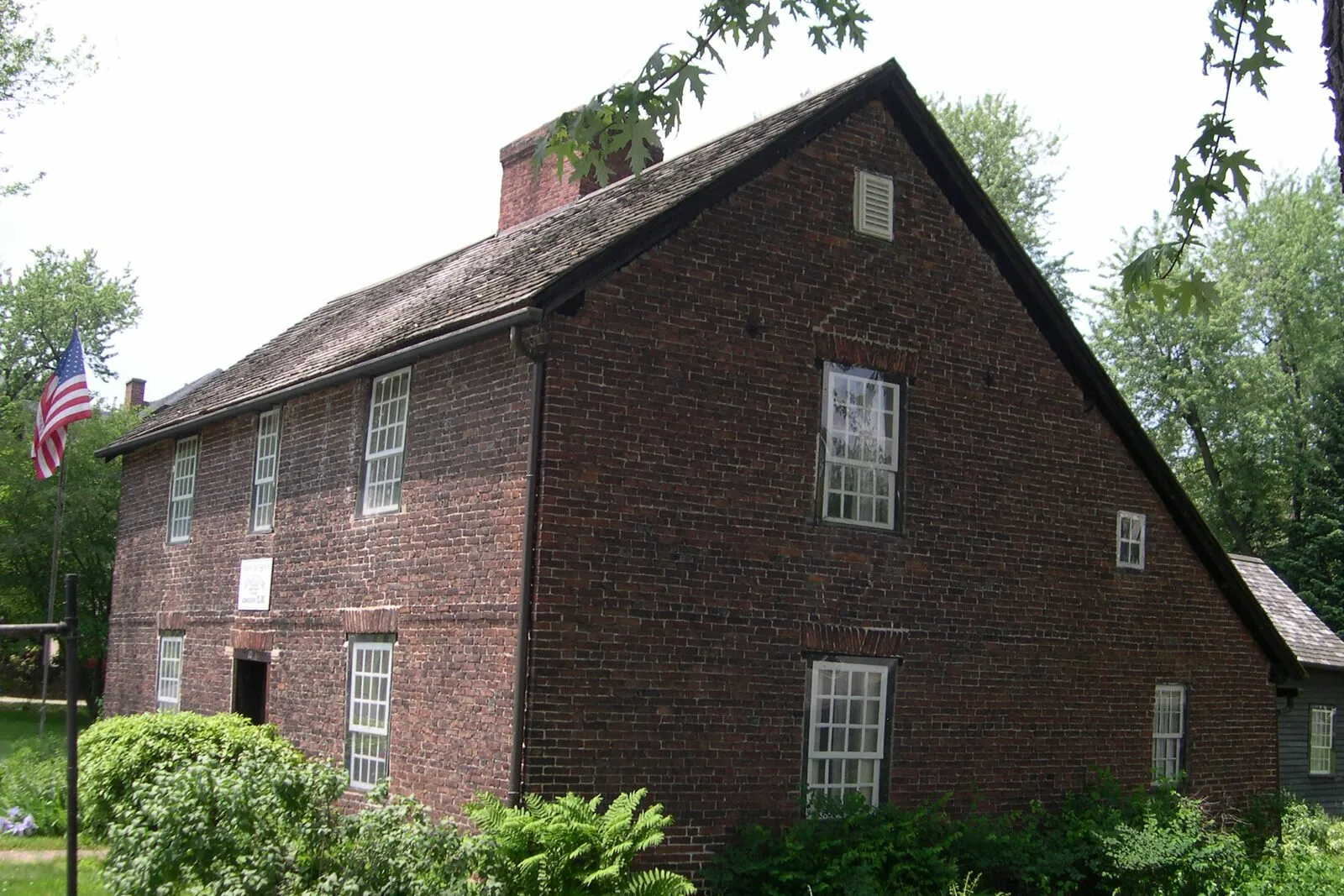
The hero image above is the Josiah Day House at 70 Park Street, just off the common, a brick saltbox built in 1754 that is the oldest surviving building in West Springfield, the oldest known brick building in Hampden County, and (per the Ramapogue Historical Society, which has owned and operated it as a museum since 1903) the oldest known brick saltbox house anywhere in the United States. It is open seasonally as a small house museum; admission is generally free or a small donation.
The Eastern States Exposition
The town’s largest attraction by a wide margin is the Eastern States Exposition, universally known as the Big E, held for seventeen days each September on a 175-acre fairground on Memorial Avenue. Founded in 1916, with the first full fair held in 1917, it is the largest agricultural fair in New England: each of the six New England states has its own dedicated state-house replica building along the Avenue of States, and the fair draws well over a million visitors each year.
Storrowton Village
On the same fairgrounds, the Storrowton Village Museum is a small open-air museum of ten historic New England buildings (houses, a church, a tavern, a schoolhouse, a barn) relocated between 1927 and 1930 from sites across Massachusetts and New Hampshire and reassembled around a recreated village green.
The project was the work of Helen Osborne Storrow (1864–1944), a wealthy Boston philanthropist who served as chair of the Big E’s home department and spent about $350,000 of her own money buying and moving the buildings. The village predates Colonial Williamsburg and Old Sturbridge Village and is one of the earliest “living-history” villages in the country. It is open year-round for tours, and the buildings are also used for weddings and other events.
On the river
The Connecticut River frontage in West Springfield has the River Walk and Bikeway, a paved path along the riverbank with views across to the Springfield skyline; the trail connects south to a similar path in Agawam. Mittineague Park at the western edge of town has a small pond and trail loops in pine-oak woods, and is the city’s largest municipal open space.