Plainfield is a small Hampshire County hill town of about 630 on the northwestern edge of the county, in the Berkshire Highlands where Hampshire meets Franklin and Berkshire counties. The town was first settled in 1770, set off from Cummington as a district in 1785, and incorporated as a separate town on June 15, 1807, making it the youngest town in Hampshire County. The town center sits at roughly 1,620 feet above sea level, and the peaks of West Mountain at 2,125 feet are the highest elevation in the county.
A town on the heights
Plainfield’s waterways are the headwaters of both the Westfield and Deerfield rivers, with a narrow upland watershed divide running across town that separates streams flowing south into the Westfield’s West Branch from streams flowing north into the Deerfield. Outside the small village center, the town is mostly woods, hill farms, and brook-cut hollows on the Berkshire-plateau highland. The 1807 separation from Cummington left Plainfield with a roughly 21-square-mile rectangle of high country and a town center clustered around the meetinghouse, the Congregational church, and a handful of houses at the crossroads.
Town center
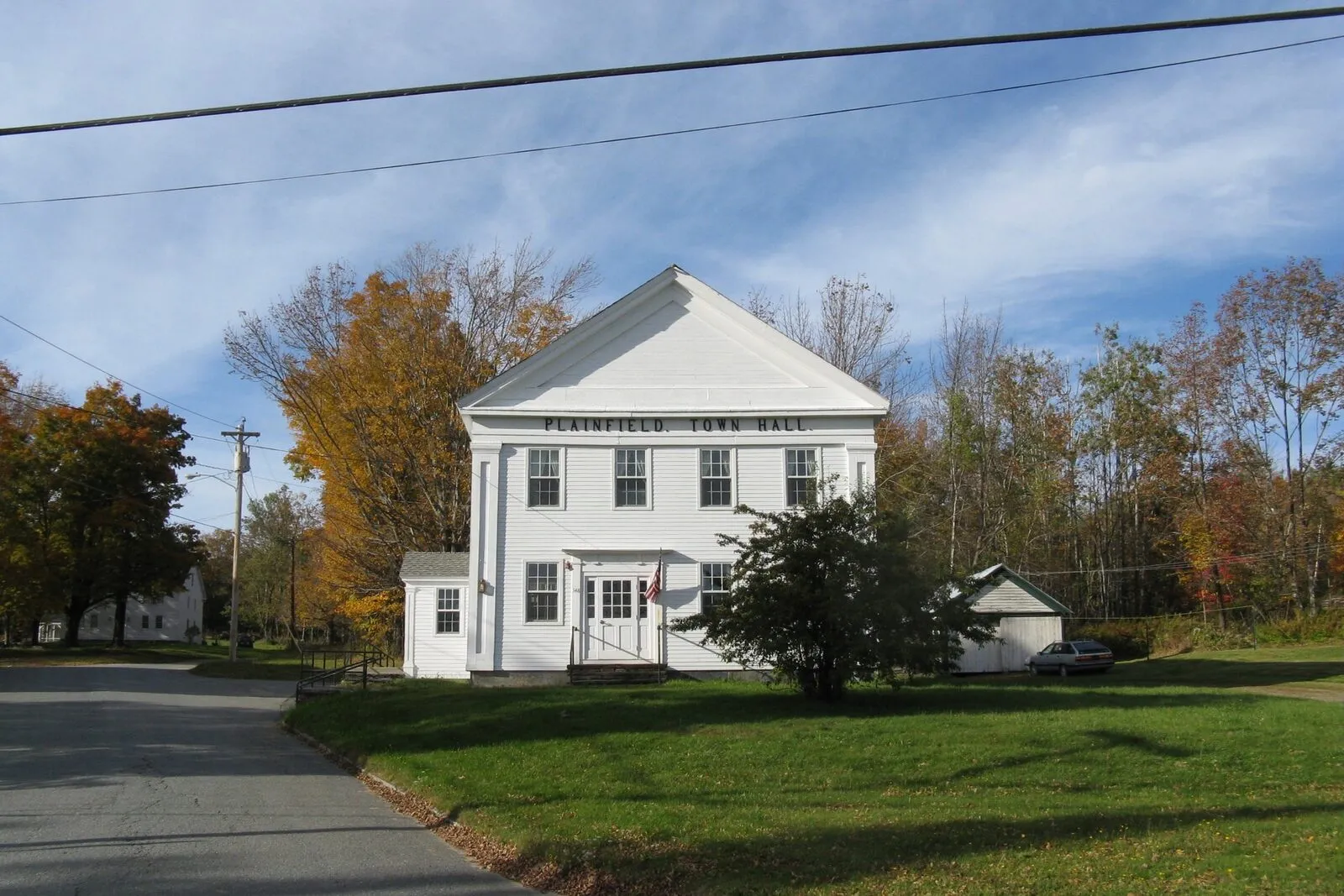
The hero image is the Plainfield Town Hall, the small white-clapboard Greek Revival civic building at the center of town. It is listed on the National Register of Historic Places. A short walk away stands the Plainfield Congregational Church, the other main 19th-century landmark of the village. The town has no commercial center to speak of (groceries and services are in Cummington to the south or further down Route 9 in the Westfield Valley), and Plainfield’s character is the quiet of a hilltop town that the railroad never reached.
Geography and roads
Plainfield is bordered by Cummington to the south, Hawley (Franklin County) to the north, Ashfield to the east, Savoy (Berkshire County) to the west, and Windsor (Berkshire County) to the northwest. Worthington sits a short drive south, on the far side of Cummington. Route 116 crosses the town from Ashfield in the east toward the Berkshires, and Route 8A runs north–south from Hawley down into Cummington. Most travel out of Plainfield is by these two-lane hill roads.
Outdoor places
- Plainfield Pond, near the town center, is the recreational pond, a small kettle-style upland pond used locally for swimming and paddling.
- Deer Hill State Reservation, on the western side of town, is a small state-managed parcel with woods walks.
- Dubuque Memorial State Forest, the largest public land in Plainfield, spans into Hawley to the north and offers the town’s principal stretch of forest road and hiking access.
Other notes
- Charles Dudley Warner (1829–1900), the Hartford newspaper editor and Mark Twain’s co-author on the 1873 novel The Gilded Age (the book that named the era), was born in Plainfield.
- Marcus Whitman (1802–1847), the missionary physician killed at the Whitman mission in present-day Washington State, was also born in Plainfield.
- The Shaw Hudson House, run by the Plainfield Historical Society, is the town’s small local-history museum, open seasonally.
Sources
- Town of Plainfield
- Plainfield, Massachusetts — Wikipedia (2020 U.S. Census population: 633)
- Charles Dudley Warner — Wikipedia
- Dubuque Memorial State Forest — Massachusetts DCR