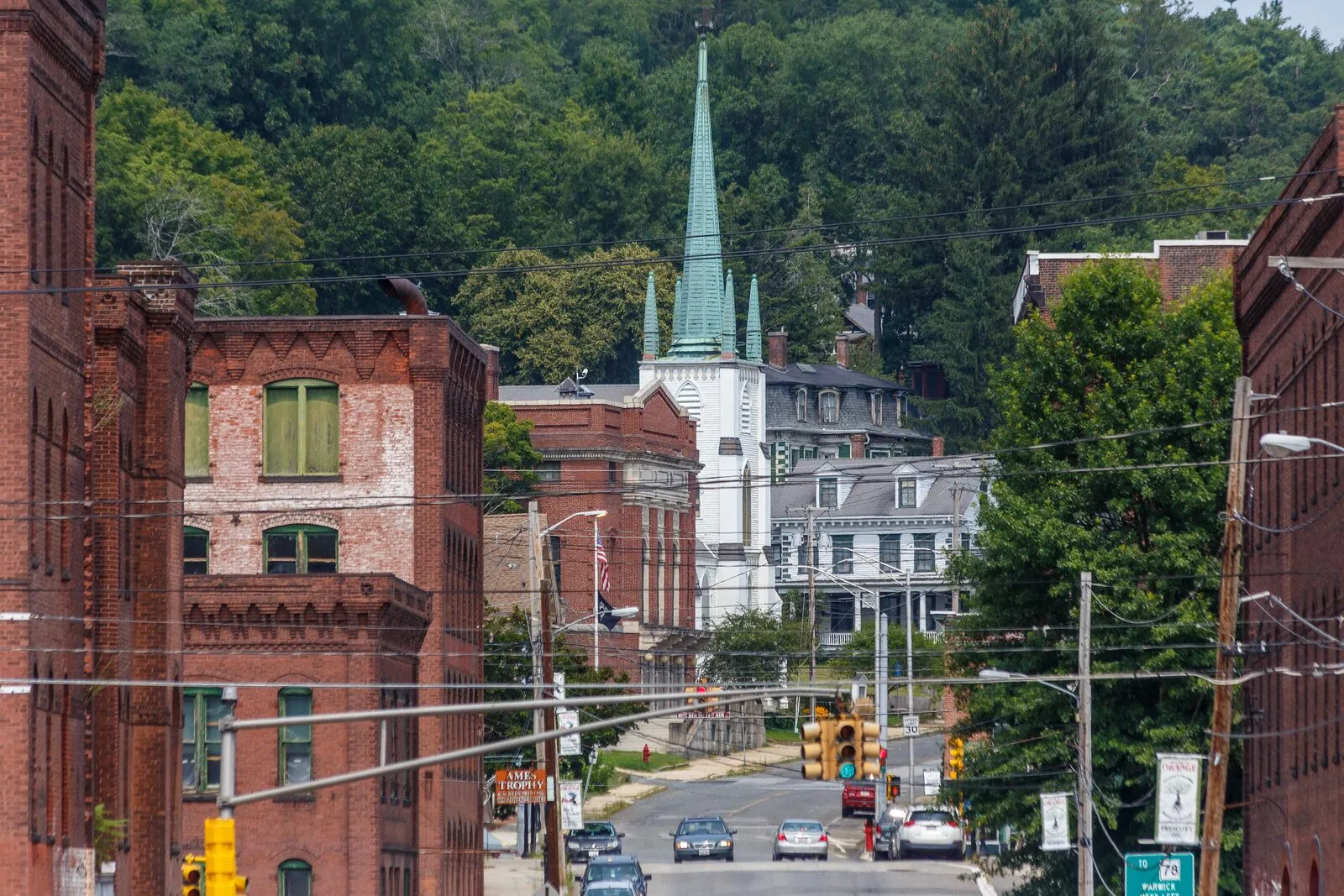
Orange is a Franklin County town of about 7,500 along the Millers River in the North Quabbin region at the eastern edge of the Pioneer Valley. The lands were detached from Athol, Royalston, and Warwick and set off as the District of Orange in 1783, then incorporated as a town in 1810 and named for William, Prince of Orange. Orange is bounded by Erving to the west, Wendell to the southwest, New Salem to the south, Athol to the east, Warwick to the north, and a short corner with Northfield to the northwest.
The Friendly Town
Orange has long gone by the nickname “the Friendly Town,” and the phrase still shows up on town signage, local businesses, and economic-development materials. The downtown, strung along South Main Street between the Millers River and the rail line, is the commercial center for the nine-town North Quabbin region organized through the North Quabbin Community Coalition since 1984: Athol, Erving, New Salem, Orange, Petersham, Phillipston, Royalston, Warwick, and Wendell. Athol, just across the Millers River line, is larger; Orange is the second-most-populous town in the group.
New Home Sewing and Minute Tapioca
Orange’s 19th- and early-20th-century industrial fabric grew up along the Millers River, where mill privileges powered a string of factories. The New Home Sewing Machine Company was the largest: by some accounts the plant was producing on the order of a million machines a year at its early-1890s peak, making it the dominant employer in town. The complex of brick mill buildings on East Main Street still stands and is being adapted to other uses.
The town’s other nationally-known industry was Minute Tapioca. The product was invented in Boston by Susan Stavers, who put manioc roots through a coffee grinder; she sold the rights in 1894 to John Whitman, an Orange grocer and publisher, who set up production in the former J.B. Reynolds Shoe Factory on the Millers River. The Minute Tapioca Company was the country’s leading tapioca producer through the 1910s and 1920s, and the Orange plant ran until 1967.
The Rodney Hunt Company, founded in Orange in 1840, is the third of the town’s long-running industrial names. Originally a maker of textile-mill machinery and water wheels, it later became a specialist in water-control gates and valves. It is still operating in town under the VAG Valve & Gate Group.
Jumptown and the airport
The Orange Municipal Airport (FAA: ORE), opened in 1929 at the northeast edge of town, is best known as the home of Jumptown, the country’s first commercial parachuting center, established at the airport in 1959 by Jacques-André Istel as Parachutes Incorporated. The drop zone has operated continuously since, and Orange’s place in the history of American sport parachuting was prominent enough by August 1962 for Sports Illustrated to run a feature (“The Whole Town’s Jumping”) on it. Jumptown still runs tandem jumps, AFF training, and licensed-jumper operations seven days a week in season, and on clear weekends the canopies are visible from the downtown bridges.
Other notes
- Tully Mountain and Tully Lake, in the northern part of town, are the most-visited natural area in Orange: a roughly 1,160-foot peak with an open ledge facing the lake, on the Tully Trail loop maintained by The Trustees of Reservations.
- The Moore-Leland Library, the Orange Historical Society, and the late-Victorian commercial blocks along South Main Street give downtown a coherent 1890s–1910s streetscape, with the Gothic-Revival Central Congregational Church (the white spire in the hero photo) at 93 South Main as its most prominent landmark.
- Orange shares the Ralph C. Mahar Regional High School with New Salem, Petersham, and Wendell, the regional pattern that organizes the small North Quabbin towns into a single secondary school.