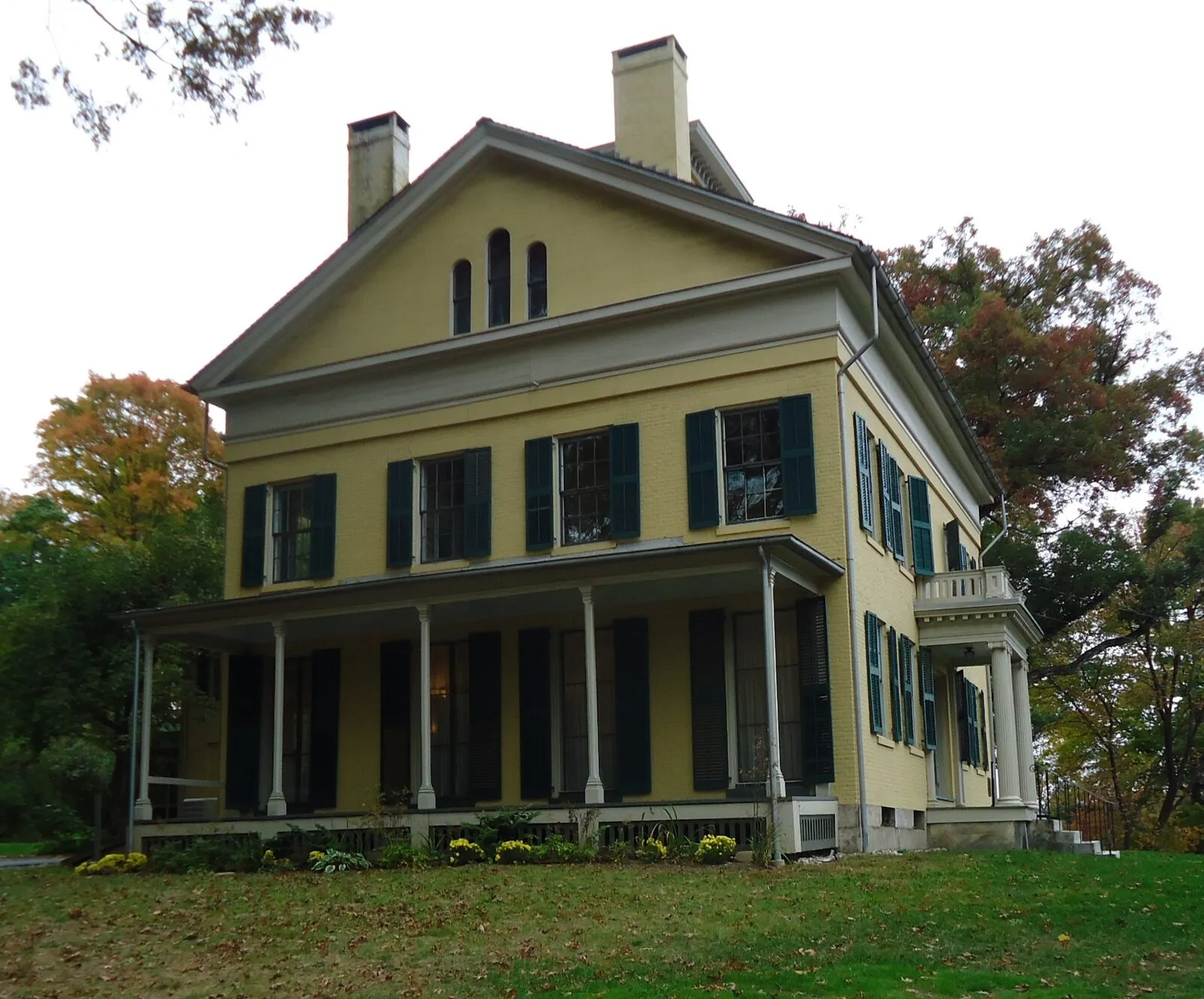
The Pioneer Valley has unusually deep literary ground for its size. Emily Dickinson lived nearly her entire life in Amherst and wrote some 1,800 poems at her family’s Homestead. William Cullen Bryant grew up forty miles away in the Cummington hills and drafted “Thanatopsis” as a teenager. The Yiddish Book Center, founded in Amherst in 1980, holds the largest collection of recovered Yiddish books in the world. And the Eric Carle Museum, a few hundred yards down the road from the Book Center, is the country’s first full-scale museum devoted to picture-book art. A day in the Valley can take in three of these on a single drive; a long weekend can reach all four.
Morning: The Emily Dickinson Museum
Start in Amherst at the Emily Dickinson Museum on Main Street, two adjoining houses on three acres: the Homestead, where Dickinson was born, lived, and wrote, and The Evergreens next door, the home of her brother Austin and sister-in-law Susan. Tours are guided and run about an hour. The museum is closed January and February and is generally open Wednesday through Sunday the rest of the year. Book ahead on weekends and during the spring/fall school-trip season. The Homestead is undergoing a multi-year exterior restoration as of 2026, but the museum stays open through the work.
If you have the time, walk five minutes south through the Amherst Common to the Beneski Museum of Natural History on the Amherst College campus. It’s not literary, but free and a useful counterweight to a heavy day of houses and texts.
Lunch: Amherst center
Amherst’s downtown is a few short blocks of North and South Pleasant Street, with a long list of cafés and sit-down restaurants. Pick what looks good; most of it is reliable.
Afternoon: The Carle and the Book Center
Drive south on Route 116 about three miles to the Hampshire College area. The Eric Carle Museum of Picture Book Art opened here in 2002, founded by author-illustrator Eric Carle and his wife Barbara as the first full-scale museum in the United States dedicated to the art of picture books. The permanent collection holds thousands of original illustrations; rotating gallery shows feature one illustrator at a time, and an on-site studio runs drop-in art workshops for families. The museum is generally open Wednesday through Sunday and closed Mondays and Tuesdays.
Walk or drive across Route 116 to the Yiddish Book Center, a research and visitor institution on land donated by Hampshire College. The 1997 building, a low cluster of wood-shingled volumes with pyramidal and conical rooflines, deliberately echoes the rooflines of an East European shtetl, the small market towns where most pre-war Yiddish literary life took place. The permanent exhibition Yiddish: A Global Culture that opened in October 2024 traces a thousand years of Yiddish writing, theater, music, and political life. Admission is by suggested donation, with members, students, and children free. The center is generally open Sunday through Friday and closed Saturdays for Shabbat. Confirm hours on the website before you go.
Day two: Bryant Homestead in the hilltowns
For a second day, drive forty-five minutes northwest to the William Cullen Bryant Homestead in Cummington. The 1783 farmhouse on the ridge above the West Branch of the Westfield River is where Bryant grew up and where, in his teens, he drafted “Thanatopsis.” He left for New York and a long career as editor of the New York Evening Post, then bought the farm back from relatives in 1865 and returned every summer for the rest of his life. The house is now a National Historic Landmark held by The Trustees of Reservations.
The grounds and trails are open daily, sunrise to sunset, free year-round, including the Rivulet Trail, a short loop through old-growth pine and hemlock down to the small stream from Bryant’s poem “The Rivulet.” Guided “Literary Legacy” house tours run on a handful of summer dates only, typically one Saturday a month from late June through September; the Trustees site is the canonical source for current dates. Plan the drive for a fall foliage day if you can; the hilltowns peak about a week ahead of the Valley floor.
Practical notes
- Distance from the Common in Amherst to the Book Center is about three miles. Distance from Amherst to the Bryant Homestead is about thirty miles, mostly on Route 9 west.
- The Dickinson Museum charges an admission ticket; the Carle and the Bryant House charge modest fees on tour days; the Book Center asks for a suggested donation; the Beneski is free.
- Most of these places are closed on Mondays, the Bryant House on most days. Check the websites before driving over.
- Spring and fall are the most pleasant seasons. The hilltowns turn first; the Valley follows about a week behind.